COG’s Climate, Energy, and Environment Policy Committee (CEEPC) developed a plan to meet the region’s greenhouse gas (GHG) emission reduction goals. The third edition of the Regional Climate and Energy Action Plan, adopted by the committee in March 2017, offers a variety of voluntary and flexible actions for local jurisdictions to implement between 2017-2020 to help reduce GHG emissions.
The region’s goals are to reduce GHG emissions to 10 percent below 2005 levels by 2012, 20 percent below 2005 levels by 2020, and 80 percent below 2005 levels by 2050. The region met its first 2012 goal, but there needs to be a significant regional effort to reach the 2020 and 2050 goals, according to the plan.
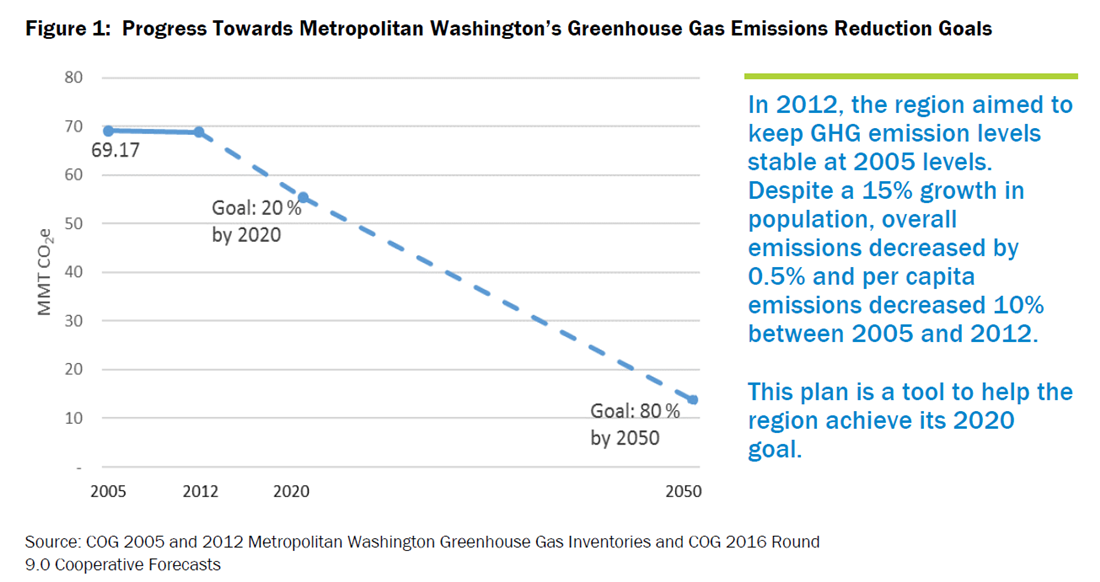
CEEPC members including government, environmental, transportation, electric, gas, business, and academic leaders developed the plan as a tool to help the region achieve its 2020 goal.
“The plan is a key step for how we will go about solving climate and energy challenges in the region,” said CEEPC Chair and Fairfax County Supervisor Penny Gross. “It offers comprehensive and holistic approaches to mitigate climate impacts in the future that are scalable depending on the jurisdiction.”
The plan’s recommendations include actions to reduce energy consumption, increase the share of renewables, advance sustainable regional mobility, increase sustainable urban development, move towards zero waste, build regional resilience, protect equity and health, and grow the regional economy. The plan is guided by the Multi-Sector Work Group’s GHG emission reduction strategies.
Additionally, the plan tracks progress towards reducing regional greenhouse gas emissions through several indicators such as:
- Grid-connected renewables (i.e. solar and wind systems) have increased from approximately 1,000 in 2010 to more than 13,000 in 2016.
- High performance buildings (i.e. verified by LEED, ENERGY STAR, EarthCraft, and Passive House) increased from under 1,000 in 2010 to more than 3,500 in 2016.
- Publicly accessible electric vehicle charging stations tripled between 2012 and 2016 from 122 to 390.
“Although there have been successes toward reducing greenhouse gases, we need collaboration at the regional level to continue making progress towards the region’s emission reduction goals,” said COG Environmental Programs Director Steve Walz.