At the February 18 board meeting, TPB staff shared the results of three recent roadway safety research efforts: the Regional Roadway Safety Study update, an inventory of roadway safety strategies used by localities in the TPB region, and the findings of a white paper on automated traffic enforcement. While the Regional Safety Study is part of the TPB’s ongoing analysis of traffic incidents and roadway-related fatality and injury rates, the inventory and white paper were undertaken at the TPB board’s request following the 2024 Regional Roadway Safety Summit and more than two years of the region not meeting its adopted safety targets. Key highlights from the February 18 presentations are shared below.
Roadway Safety Study Update
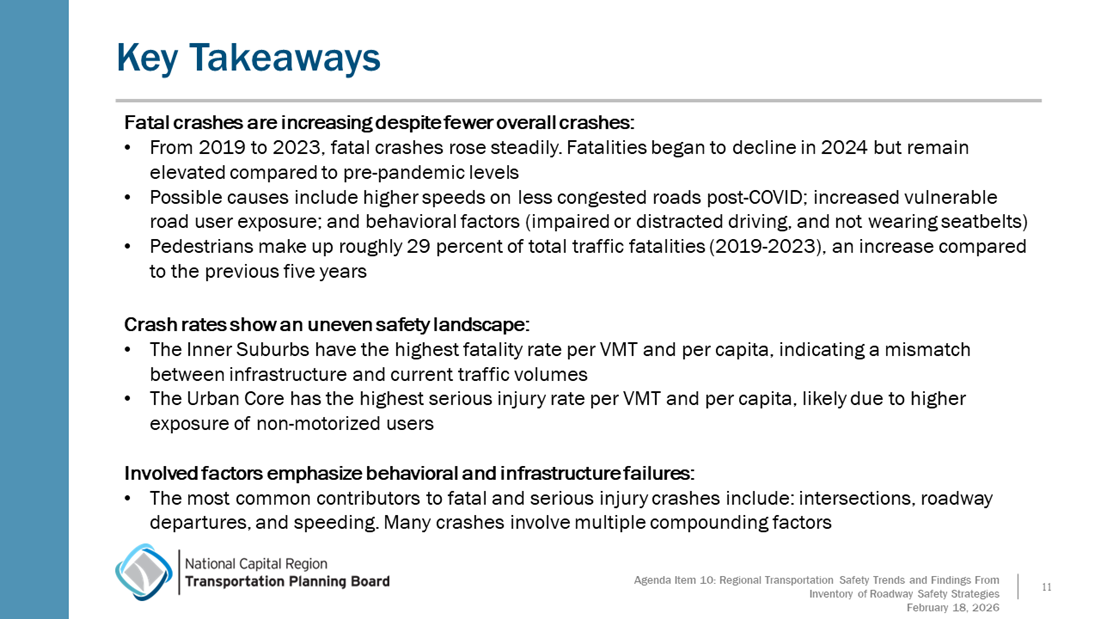
TPB’s Regional Roadway Safety Report focuses on data collected from the 2019-2023 period. The region’s long-term trend has been that fatalities have increased while serious injuries have decreased, meaning that crashes have become more severe. TPB Transportation Planner Janie Nham noted that, in 2024, the region saw a reverse of these trends with fatalities declining and serious injuries increasing slightly. Across the region, the fatality rate increased nearly 30 percent compared to the previous study period of 2013-2017, while the serious injury rate was low except for the Urban Core (District of Columbia, City of Alexandria, and Arlington County). The study shows that within the TPB region, the fatality rate is highest in the Inner Suburbs while the serious injury rate is the highest in region’s inner Urban Core.
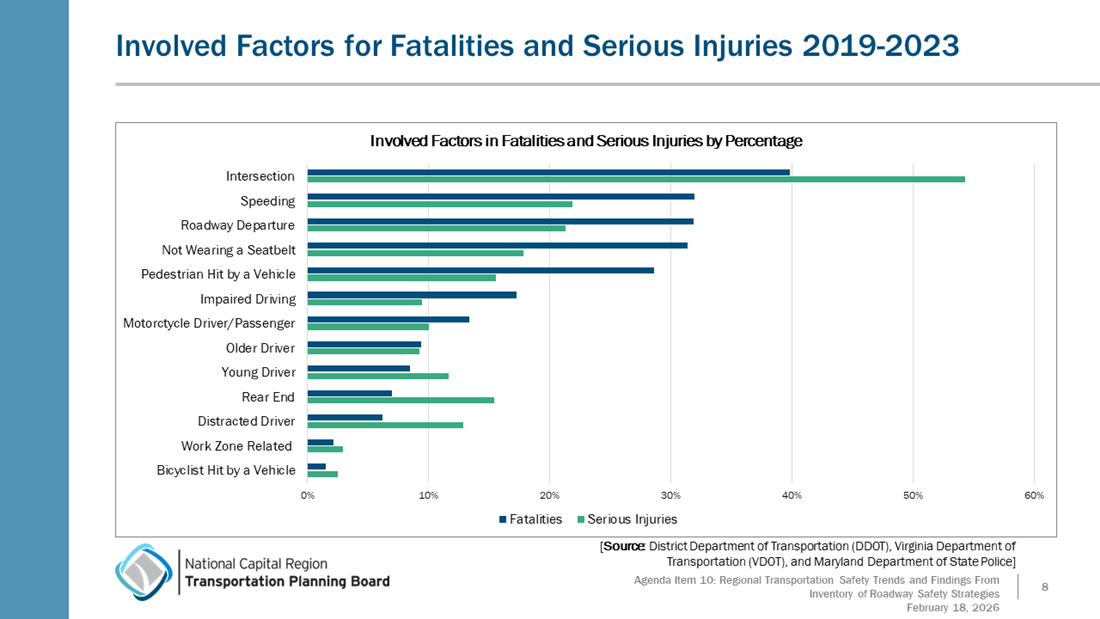
Looking at involved factors that lead to fatalities and serious injuries during the study period, intersections were the most common contributor, being involved in 40 percent of fatal crashes. Behavioral factors such as speeding, not wearing a seatbelt, and impaired driving also contributed to a large percentage of fatalities and serious injuries. Many of these trends worsened during the study period with speed-related fatalities jumping 67 percent in 2020 while impaired driving-involved fatalities and unbelted fatalities both jumped 50 percent in 2020. The percentage of young drivers involved in fatal crashes jumped by 72 percent.
The behaviors mentioned above, in addition to infrastructure factors, have been top contributing factors to fatal and serious injury crashes in the National Capital Region.
Local Roadway Safety Strategies
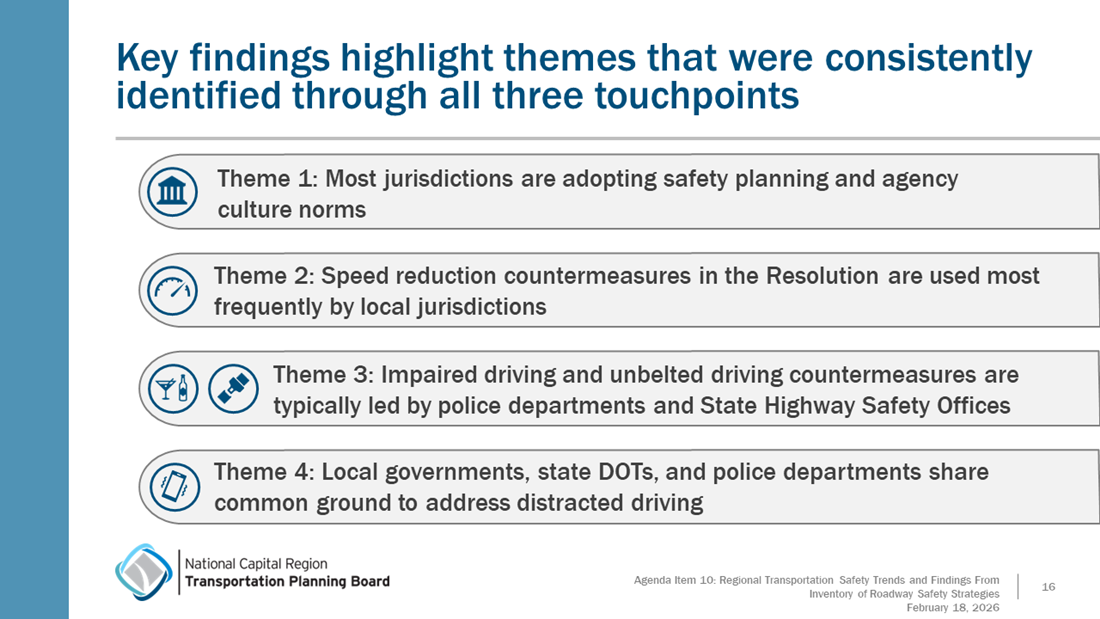
The TPB collaborated with Fehr & Peers last year to prepare an inventory of Local Roadway Safety Strategies and to determine whether TPB jurisdictions were in alignment with the TPB’s adopted Resolution R3-2021 which “reaffirms road user safety as a top priority and prioritizes the implementation of projects, programs, and policies to reduce the number of fatal and serious injury crashes on the region's roadways.” The resolution also spotlighted four areas to focus regional safety efforts: speeding, impaired driving, distracted driving, and unbelted driving.
The local inventory consisted of a review of safety plans, a jurisdictional questionnaire, and interviews. The overarching questions driving the inventory were: Does each jurisdiction focus on the four key areas highlighted in the resolution? What strategies does each jurisdiction use to address those topics? How effective have those strategies been? Nicole Waldheim, a principal at Fehr & Peers, shared the results.
Most jurisdictions are thinking about safety in some way with speed solutions being cited and used the most by the region’s local governments. Impaired and unbelted solutions are being implemented more so by law enforcement and highway safety offices and less so by local government planners and engineers. Fifteen of 22 jurisdictions in the region have completed or are developing a safety plan, whether a Safe Streets for All (SS4A) or Vision Zero plan.
In terms of strategies, local jurisdictions are using a variety of speed-reduction strategies. Traffic calming treatments and road diets stand out as common, effective ways to address speed. Twenty jurisdictions identified traffic calming as being effective. There can be pushback to road diets, and jurisdictions are finding that they have to be strategic in terms of where they're being implemented based on the data.
Automated enforcement cameras and fatal crash reviews are used by multiple jurisdictions depending on state legislation. Speed limit reduction is another strategy used across the region; however, local agencies remarked that, as an individual treatment, it is not effective unless included with other enforcement strategies.
Local law enforcement is taking the lead in the areas of impaired and unbelted driving through midnight patrols, strategic targeted enforcement, and engaging with bars and vendors to prevent drunk driving. Seatbelt enforcement and education typically relies on grants that go to law enforcement agencies to do some sort of saturation patrol. Click It or Ticket campaigns are being used across the region. Strategies implemented to address distracted driving range from community-focused messaging to engineering solutions such as speed humps, road diets, and bike lanes.
Automated Enforcement Practices
The third and final part of the safety presentation focused on automated traffic enforcement in the region, how well speed and red light cameras reduce severe crashes, and what practices can help make programs publicly supported as well as fair and reliable. Lessons learned from DC, Maryland, and Virginia are featured in the report, offering a foundation for the TPB to be able move forward and support local governments.
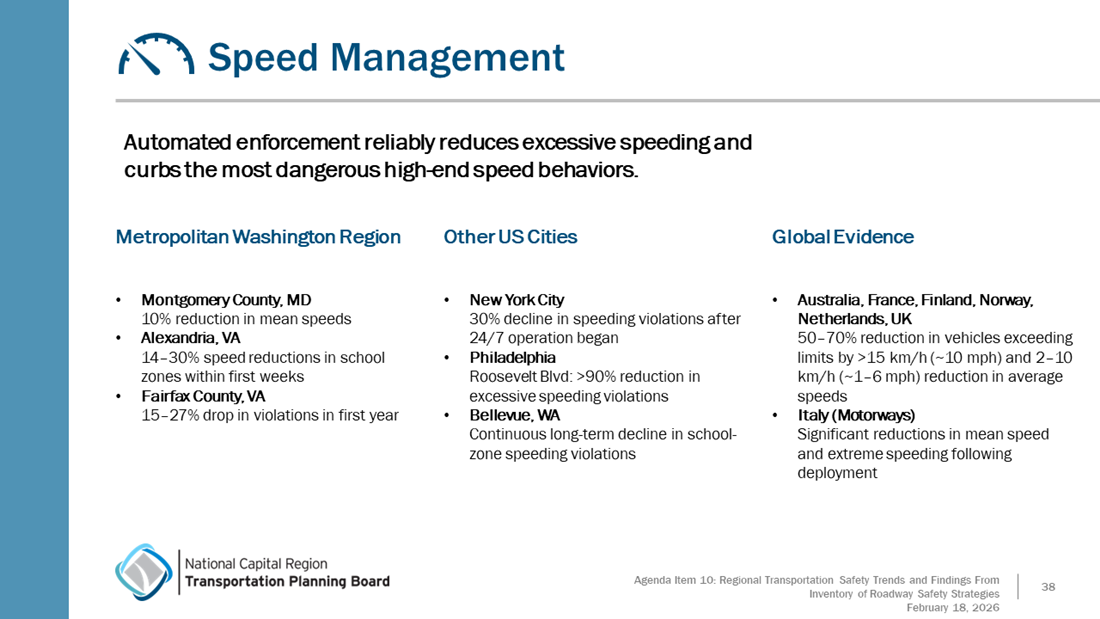
Based on evidence, automated enforcement can lead to reductions in fatalities and serious injuries of 20 to 37 percent. Case studies show that Montgomery County reported a nearly 40 percent reduction in the likelihood of fatal and serious injury crashes on enforced corridors. Both the City of Alexandria and Fairfax County have seen early improvements in their localized crash risk. In addition, early deployments of DC’s cameras did produce a 30 percent reduction in injury crashes. This region’s results are bolstered by similar numbers seen at the national and international levels. Montgomery County, Alexandria, and Fairfax County have experienced reductions in average speeds or violations when cameras are installed.
Next Steps
The board’s discussion at the February meeting reinforced that state laws may limit a jurisdiction’s ability to implement preferred local strategies. Board members expressed interest in continuing to identify effective strategies and results to present to state legislators in order to effect change at the state level. Other next steps:
- TPB Safety Subcommittee Meeting on Enforcement Collaboration - TPB will hold an “Invite Your Enforcement” safety subcommittee meeting focused on coordination between DOTs and law enforcement.
- Impaired Driving Strategies – TPB will compile and share a concise set of regional best practices on impaired driving prevention.
- Technical Assistance for Small Agency Staff – TPB will contact member agencies with smaller staff to identify safety technical assistance needs that TPB can support.
- Before-and-After Analyses – TPB will inventory project studies that conducted before-and-after evaluations, then synthesize results, methods, and metrics.
- Ticket Reciprocity and Broader ATE Deployment – TPB will coordinate with the Metropolitan Washington Council of Governments (COG) to promote enabling broader deployment in MD and VA (beyond school zones, work zones, and buses) and encourage ticket reciprocity as a legislative priority.
For questions about TPB’s safety programs and initiatives, contact Janie Nham, jnham@mwcog.org.