Documenting demographics, travel patterns, and daily travel activities is vital for understanding how the National Capital Region is growing, where development is occurring, and how the transportation system in the metropolitan Washington area is affected by, as well as determines, personal travel choices.
Planners and local agencies rely on a regionwide data collection effort, the Regional Travel Survey (RTS), to learn how often people travel, what types of trips they make each day of the week, and how long they spend commuting or taking personal trips.
About the Regional Travel Survey
The National Capital Region Transportation Planning Board (TPB) has conducted this household travel survey every decade since 1968. The most recent survey took place in 2017/2018. The upcoming 2026 survey will be the first conducted since the coronavirus pandemic and the first under the new four-to-five-year survey cycle.
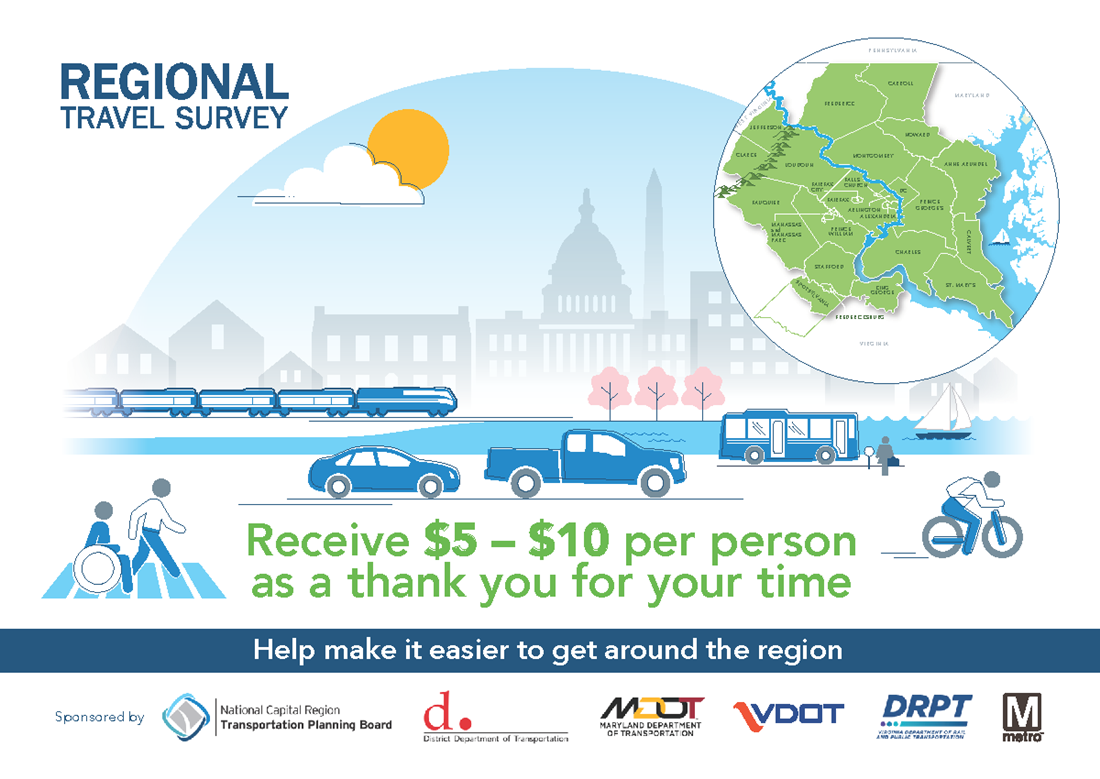
The TPB is working in partnership with the District Department of Transportation, Maryland Department of Transportation, Virginia Department of Transportation, Virginia Department of Rail and Public Transportation, and the Washington Metropolitan Area Transit Authority (WMATA) to implement the survey and encourage participation from households that receive invitations.
The RTS collects travel information within a large geographic area bounded by the Pennsylvania border, the Chesapeake Bay, Southern Maryland and Fredericksburg, and the Blue Ridge Mountains. All types of trips are documented—whether by auto, bus, train, walking, cycling, or micromobility. The survey also captures shared rides, ride hailing, and delivery trips. For this reason, the RTS provides the most comprehensive look at how residents of DC, suburban Maryland, and Northern Virginia use the region’s transportation network.
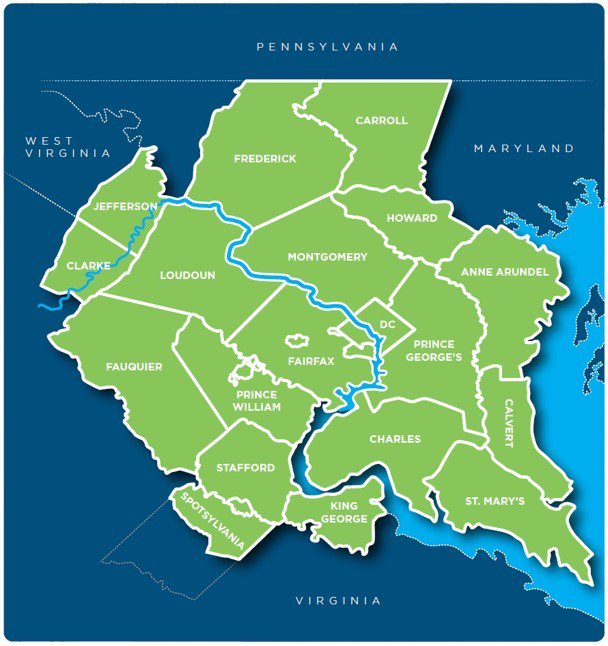
Regional Travel Survey travel information boundary (COG)
Why is the Regional Travel Survey important?
During the 2017/2018 survey, about 16,000 households completed both the demographic and trip reporting sections of the RTS. In total, more than 120,000 trip records were collected. This is important because the information gathered during the RTS serves as the primary input for the TPB’s travel demand model. The model is used to develop regional travel demand forecasts and informs local and regional transportation planning decisions.
Data gathered from this survey will help planners and community leaders understand transportation needs and support decisions about future roadway, transit, and alternative transportation projects, ultimately enhancing access to jobs, schools, healthcare, and leisure activities across the region. Survey responses will also benefit households by helping guide future transportation improvements, including enhancements to roads, transit facilities and services, bike routes, and sidewalks.
What information is collected?
RTS collects data on household size, housing type, household demographics, number of vehicles, and typical commuting trips. The survey also asks participants to report details about each trip taken, including the travel mode used (such as auto, transit, walking, cycling, or micromobility), trip origins and destinations, and the general purpose of each trip.
What to expect for the 2026 survey
This will be the first RTS conducted using a smartphone app, in addition to a web-based survey. Households across the region will be invited to participate through a random selection process to ensure that a wide range of households is represented. If your household receives a postcard invitation, signing up to participate takes about 10 minutes. On their assigned travel date, households will record the trips they take. The web-based survey collects trip information for a single day, while the app-based survey records trips over multiple days. Information collected from participating households will be privacy-protected and kept in strict confidence.
What is the survey timeline?
The pretest for the survey is currently underway. The main survey data collection effort will be conducted from April through June 2026, with another wave likely in the fall. Initial analysis from the survey will be released in 2027.
The TPB will share more about the RTS in the months ahead. Look for updates on the COG website and in COG and TPB newsletters. Be sure to subscribe to stay connected.
For information on the RTS, contact Dr. Kenneth Joh, TPB Principal Statistical Survey Analyst, kjoh@mwcog.org.
Read about the results of the 2017/2018 survey:
4 questions about the TPB's Regional Travel Survey - TPB News - News | Metropolitan Washington Council of Governments
Four travel trends from the TPB's Regional Travel Survey - TPB News - News | Metropolitan Washington Council of Governments