Following years of coordinated regional action to reduce air pollution, the metropolitan Washington region is officially meeting the 2015 federal ozone standard and is taking the final step to receive certification from the U.S. Environmental Protection Agency (EPA) of this milestone. As of now, the region meets all current federal air pollution standards.
COG’s Metropolitan Washington Air Quality Committee (MWAQC) yesterday approved a formal Redesignation Request and Maintenance Plan, and air quality agencies in the District of Columbia, Maryland, and Virginia will now submit the plan to the EPA for review and consideration. If approved by the EPA, the region will officially transition from a moderate nonattainment area to an attainment area under the federal Clean Air Act.
Data from the region’s 14 air quality monitors show that metropolitan Washington met the 2015 federal health standard for ground-level ozone by its 2024 deadline and continues to lower pollution levels. The committee’s newly approved plan proves these gains come from lasting pollution cuts and outlines how the region will keep air clean through 2038, including strict caps on vehicle emissions and backup pollution controls if ozone levels ever rise. This progress stems from regional planning through MWAQC and action on cleaner power plants, cleaner vehicles, solar energy, and transit like Metro. It also reflects everyday actions to reduce pollution by area residents, who stay informed about air quality through COG’s daily forecasts and Clean Air Partners public outreach.
"Securing formal attainment status under the Clean Air Act confirms that residents are breathing air that meets federal health standards, directly lowering the risk of asthma attacks and heart and lung disease," said MWAQC Chair and City of Falls Church Council Member Dave Snyder. "By investing in clean energy and strong emissions standards, local and state leaders have turned long-term environmental goals into everyday health protections.
Beyond public health, this designation also protects federal funding for major transportation projects while keeping existing pollution controls in place, ensuring future regional growth continues to meet clean air goals.
Additionally, during Wednesday's meeting, COG staff also presented the 2026 Ozone Season Summary, which highlights a positive season and declining long-term pollution trends across the District of Columbia, Maryland, and Virginia. In 2026, the region experienced five unhealthy air days – four “Code Orange” unhealthy air days and one “Code Red” day driven by wildfire smoke. For comparison, the region recorded 13 unhealthy air days in 2016 and 51 in 2006 based on the current standard.
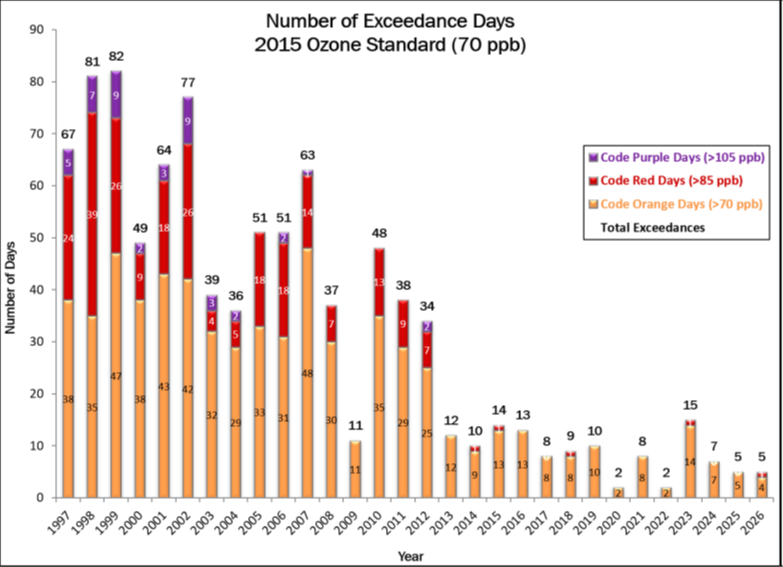
Chart shows overall number of unhealthy air days continues to decline in region
Ozone levels increase when high temperatures and low wind combine with local emissions and pollution transported into metropolitan Washington from outside the region. COG data shows that, in recent years, multiple contributing factors must occur at the same time to trigger an ozone exceedance, such as the out-of-region wildfire smoke that resulted in the single Code Red day in 2026. Previously, a simple combination of high temperatures and low wind could create high ozone conditions.
Learn more and download the maintenance plan and redesignation request here
Download the full 2026 ozone season summary here