On May 21, the TPB approved new project funding for the Transportation Land Use Connections (TLC) and Regional Roadway Safety (RRSP) Programs and received updates on the TPB’s safety initiatives. Staff also provided information about COG’s Regional Activity Centers and regional bicycle and pedestrian planning. All agenda items, presentations, and the recorded livestream are available on the May TPB meeting page.
Transportation Land Use Connections and Regional Roadway Safety project approvals
TPB planners Victoria Caudullo and Janie Nham presented nine recommended projects for funding under the TLC and RRSP programs. The board approved $440,000 for five TLC projects focused on advancing planning and preliminary engineering efforts that encourage mixed-use development and support transit access. $320,000 was approved for four roadway safety projects. Learn more about the projects—all designed to improve walkability and bicycle access—in the recent TPB news release.
TPB Safety Activities update
Janie Nham provided an overview of TPB’s 2025 safety activities. In October 2024, the TPB held a Regional Roadway Safety Summit which identified recommendations and a work plan. As a result, several safety studies have been included in the FY 2026 TPB work program.
January 2025 Allies in Action: The TPB joined USDOT’s Allies in Action campaign. Through this campaign, the TPB will coordinate with the District DOT, Maryland DOT, Virginia DOT, and TPB member cities and counties in suburban Maryland and Northern Virginia on safety activities.
Summer/Fall 2025 studies: The TPB, in coordination with a consultant, will prepare a study to inventory and benchmark roadway safety activities of the region’s jurisdictions relative to the TPB’s 2020 safety resolution. A second study will focus on understanding the impact of automated traffic enforcement devices on safety outcomes.
Ongoing 2025 reciprocity coordination: COG is leading the exploration of mutual agreements for automated traffic enforcement reciprocity between the District, Maryland, and Virginia. The TPB will develop a white paper that reviews the legislative landscape for automated traffic enforcement as well as opportunities and constraints for reciprocity.
Regional Safety Study update: COG is in the midst of updating the study and is finalizing analysis for the report, which will be presented to the TPB.
Street Smart: In April, the Street Smart safety campaign was visible across the region—from transit ads to the street team’s walking billboards.
TPB staff will continue to share progress on the region’s safety initiatives in the coming months.
Regional Activity Centers Update
TPB Planning Data and Research Program Director Timothy Canan and COG Regional Planner Greg Goodwin presented an overview of COG’s Regional Activity Centers. The concept of activity centers dates to the 1990s as part of the TPB’s vision “to help develop an interconnected transportation system that would enhance the quality of life and promote a strong and vibrant economy.” Activity centers are walkable, containing a mix of jobs, services, and recreation. Today, activity centers are designed to “bring jobs and housing closer together”—one of the aspirational elements of the TPB’s current long-range plan, Visualize 2045.
Regional Activity Centers (RACs) are designated in a jurisdiction’s adopted comprehensive/general plan or other locally adopted land use plan. In addition, in the planning horizon year (2050), the centers have a person per acre density (employment plus population) that falls within the top one-half of densities within the jurisdiction. Secondary attributes include at least two of the following: a mix of land uses, transit service by 2050, housing and transit affordability, and an intersection density of greater than 55 intersections per square mile. Activity Centers are part of the selection criteria for the TPB’s technical assistance programs. Also, when jurisdictions submitted their proposed projects for the Visualize 2050 plan, agencies were asked if the projects are located in or near regional activity centers or advance the concept of activity centers.
Greg Goodwin noted that the current Round 10 activity centers map was approved by the COG Board on May 14, 2025, and includes 145 centers. As shown in the figure below, the centers are forecasted to grow at a faster rate than the region as a whole, with activity centers projected to grow by 35 percent from 2020 to 2050 compared to 24 percent outside of the regional activity centers.
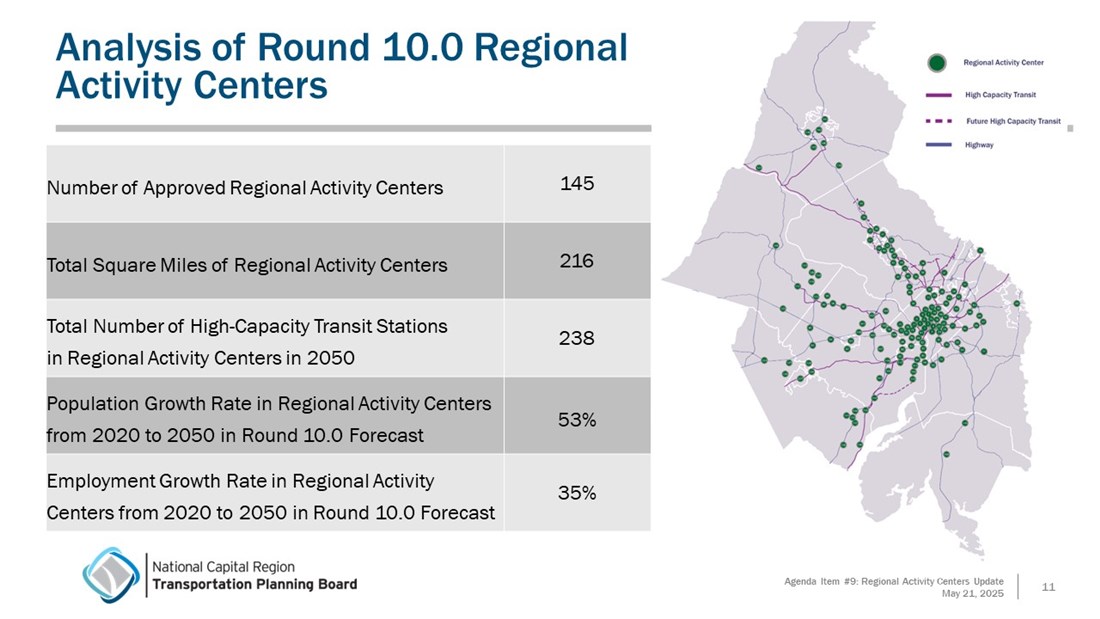
(COG)
Regional Activity Centers Q&A
Maryland DOT Senior Policy Advisor Drew Morrison asked how the TPB can reinforce good land use planning decisions through its work. In response, TPB Staff Director Kanti Srikanth noted the example of how the TPB’s technical assistance grant programs use RACs as one selection criteria along with linkages to high-capacity transit (HCT) stations. RACs have three aspects: concentrated land use, connectivity to HCTs, and walking/biking circulation for people within the RAC. Srikanth said that TPB members are urged to prioritize connecting RACs with HCT and internal circulation within RACs as they make their project investment decisions for the region's long-range transportation plan.
Srikanth mentioned that the TPB brings data and analysis to local and state decision-makers. For example, each time the TPB updates its long-range transportation plan, staff examines if projected growth in population and employment is happening inside or outside of activity centers and assesses what transportation investments are being made in those areas.
Arlington County Board Member Susan Cunningham asked how or if COG and the TPB might incorporate recent changes in work and commute patterns into Regional Activity Centers-related work. Cunningham asked whether commute patterns have caused disruption or if the centers are staying evergreen despite changes.
Kanti Srikanth responded that the regional activity center designations are reexamined and redesignated every four to five years when the region revisits employment and population growth projections. The most recent Round 10.0 regional cooperative forecast was a post-COVID activity and the region’s planning directors examined how the growth trends in the region may have been affected by the pandemic. TPB is also looking at big data to inform growth trend patterns in the region; however, big data is high level and activity center information is at a small geographic level.
Greg Goodwin commented that COG is currently working on a Round 10.1 cooperative forecast and anticipates starting the process for a major forecast round in the next year or two which will incorporate information about potential reductions in the federal workforce.
Bicycle and Pedestrian Network update
With new TLC and Regional Roadway Safety projects helping communities around the region complete trail connections and improve walkability, TPB Planner Michael Farrell continued the discussion by providing updates on TPB bicycle and pedestrian planning activities, including a micromobility workshop for TPB Bicycle and Pedestrian Subcommittee members on June 30. Other updates covered the National Capital Region’s Bicycle and Pedestrian Plan, and the status of the National Capital Trail Network—which will be updated in the coming year.
TPB staff is tracking progress toward completion of the planned 779-mile National Capital Trail Network (NCTN). Approximately 27 miles per year are being built, and the TPB will update the network map with a 2050 horizon and plans to finalize the network update and related planning resources for TPB members by the end of 2026.
Chairman's Remarks and Director's Report
TPB Chair James Walkinshaw and members of the board reflected on the recent passing of U.S. Representative Gerry Connolly, offering condolences and remarks on the legacy of his public service. Read the TPB's formal message about Representative Connolly and former Fairfax Supervisor Catherine Hudgins's leadership.
The Director's and Steering Committee Reports, TIP amendments, letters of support, TPB's reauthorization principles, and notice of determination of attainment and clean data determination for the Washington DC-MD-VA nonattainment area for the 2015 Ozone National Ambient Air Quality Standard, are included in Item 5 on the May 2025 TPB meeting page.
Stay Connected
The TPB board next meets on June 18 at 12:00 P.M.
Follow the TPB (NatCapRegTPB) on Facebook, Instagram, and Twitter.