Rush hour congestion, severe weather, and construction zones—travelers in the metropolitan Washington area are no strangers to the variety of events that affect daily traffic conditions in the District of Columbia, suburban Maryland, and Northern Virginia. From snowstorms that are talked about days in advance to unpredictable incidents such as downed power lines or a tractor trailer overturning on an interstate ramp, even just one incident can have a ripple effect across the three state jurisdictions, the region’s transit systems, and the towns, cities and counties of the National Capital Region (NCR).
According to Visualize 2050, the NCR Transportation Planning Board (TPB)’s recently approved metropolitan transportation plan, during 2025 more than 18 million trips were made daily in the planning area. Approximately 81 percent of those trips were made by personal vehicle. Residents and visitors making those journeys rely on GPS, local text alerts, social media and mobile applications or radio for the latest updates on road, bus, and rail service. However, when they receive an alert or hear a traffic report, travelers may not be aware of the behind-the-scenes efforts that go into coordinating incident management and response and the role that the Metropolitan Washington Council of Governments (COG) and the TPB have in supporting the transportation network’s return to a safe operational status.
MATOC program helps reduce travel delays and improves agency-to-public communication
One of the key groups in the region’s coordination partnership is the Metropolitan Area Transportation Operations Coordination (MATOC) program. The TPB helped to form MATOC in the 2007-2009 timeframe, and today, MATOC is a joint operations program between DDOT, MDOT, VDOT, and WMATA. MATOC’s goal is reflected in its tagline, “Working together to reduce incident-based travel delays through better coordination, communication, and information sharing.”
The program is administered through the University of Maryland Center for Advanced Transportation Technology (CATT) and is governed by its steering committee which is supported by several MATOC subcommittees on traffic operations, transit operations & planning, maintenance, operations, and information systems.
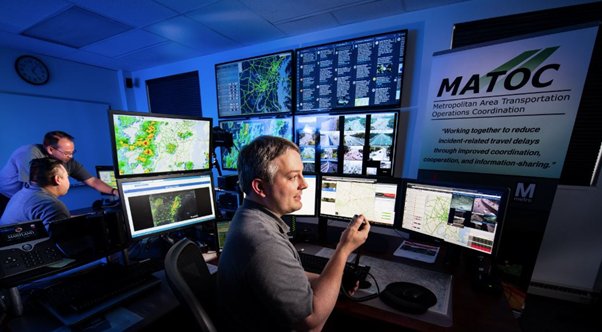
MATOC Operations Center at the University of Maryland
MATOC focuses its monitoring capabilities on the NCR's transportation network during non-holiday weekday A.M. and P.M. rush periods, as well as during severe weather and special events. A particular focus is on traffic-related incidents that occur on or impact freeways, interstates, major arterials, commuter routes, border crossings, and river crossings that have potential cascading impacts across the region. Approximately 60 percent of MATOC’s incident management involvement and communications relates to incidents lasting from 30 minutes to two hours in duration.
“When local traffic management staff is focused on the scene of an incident, MATOC is able to take a regionwide view and provide an understanding of how the entire network from north of Baltimore to Richmond to the Eastern Shore to the Blue Ridge Mountains is affected,” said Taran Hutchinson, MATOC Program Facilitator. “We pitch in to look at what is happening on the roads, call other transportation agencies to let them know, and recommend what actions could be taken to alert motorists.”
Through its coordination role, MATOC provides its stakeholders situational awareness of transportation operations across the NCR, offers communications support, incident monitoring, and post-event analysis. The MATOC program continues to explore opportunities to bring more traffic incident responders to the MATOC table including transportation/tolling/transit agencies,law enforcement, fire/rescue, towing, as well as the media who communicate directly with the traveling public.
COG offers resources to facilitate regional emergency response and winter weather planning
The Regional Emergency Support Function Transportation Emergency Preparedness (RESF-1) Committee coordinated by COG is the regional forum for transportation's role in emergency preparedness and response—before, during, and after incidents. As part of this function, COG provides a regional framework for mutual aid and supports the NCR Winter Weather Plan. The RESF-1 Committee convenes monthly and is comprised of officials who represent local, state, and federal government, transportation and emergency management agencies, and other private sector transportation and transit entities. Committee members have access to resources including peer-to-peer information sharing, a regional Traffic Incident Management (TIM) self-assessment, training opportunities, and pathways for supporting operational coordination.
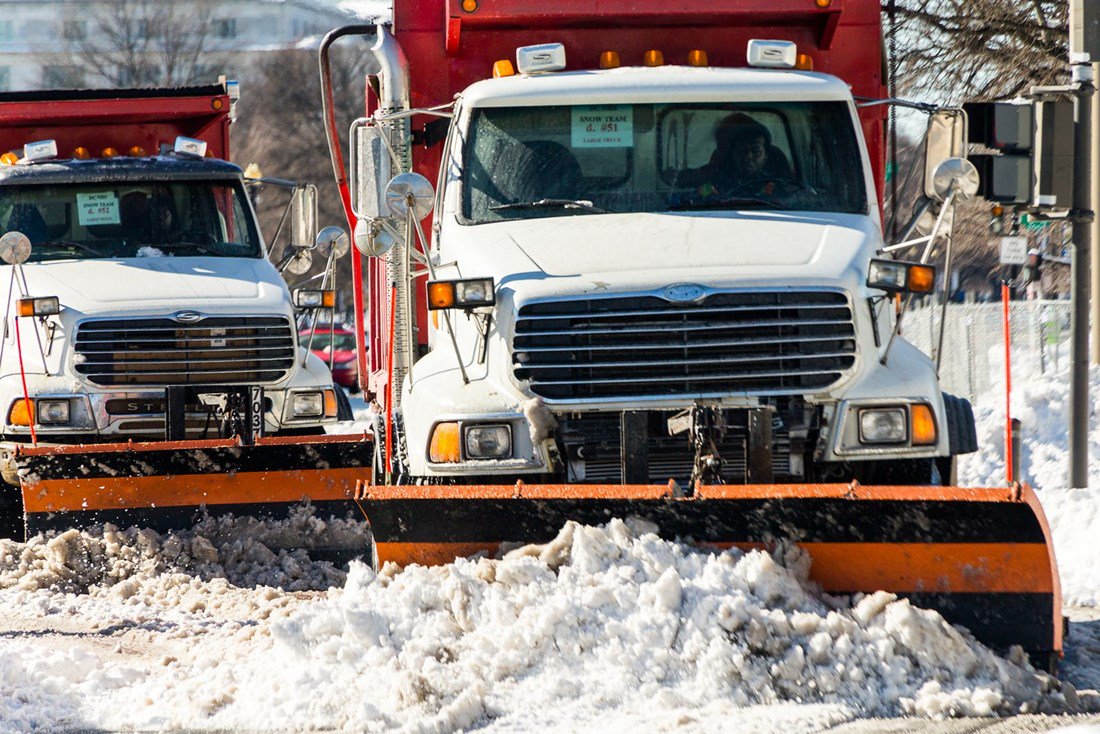
Snow plows on Pennsylvania Avenue in Washington, DC (Steven Green/Flickr)
In addition, COG annually convenes several hundred local, state, and federal decision-makers and regional partners to coordinate severe weather response in the region—including chief administrative officers, public information officers, operation centers, transportation and transit leaders, fire/rescue, emergency management, health and medical, law enforcement, and the U.S. Office of Personnel Management (OPM). Coordination is supported year-round through a regional Mutual Aid Agreement (MAA) that originated after the events of September 11, 2001.
In 2004, Congress passed the Intelligence Reform and Terrorism Prevention Act which provides authority specific to the NCR for the MAA. The Act serves as the policy bedrock of all regional mutual aid plans for its authorization for inter- and intrastate mutual aid. The Act defines the NCR to include TPB member jurisdictions, any jurisdiction that shares a border with a member, the Washington Metropolitan Area Transit Authority (WMATA), and the Metropolitan Washington Airports Authority (MWAA). Federal entities are considered covered by the Act.
COG’s MAA is underpinned by Mutual Aid Operations Plans (MAOP), including the Transportation Mutual Aid Operations Plan (TMAOP). Signing a MAOP operationalizes the MAA and provides benefits for participating jurisdictions, including resource sharing for supplies, vehicles, equipment, and personnel during a crisis or planned event. Signing the TMAOP does not require additional cost to a jurisdiction and enables resource sharing and training opportunities for transportation and transit entities.
“The Transportation MAOP and other mutual aid plans in the region are the perfect vehicle for rapid resource sharing from neighboring jurisdictions,” said Eli Russ, COG Senior Public Safety Planner. “Weather events are an example where certain parts of the region may be more impacted or recover more quickly than others. Where contractor resources are running low, a lot of agencies have staffing challenges as well, and it becomes incumbent on COG members to leverage collaborating opportunities. Having agreements like this signed and ready to go so that when that bad day does come, everybody's ready to help each other.”
Coordination around transportation system operations and incident response reflects COG’s ability to mobilize the region quickly and efficiently to serve its member governments. In addition, agency-to-agency and regional coordination is vital for the TPB to meet its goals of safety, travel time reliability, efficient transportation systems management, and supporting a high quality of livability for all people in the region. Signing the TMAOP provides TPB jurisdictions access to an organized operations and management assistance support network.
COG and the TPB encourage members to learn more about MATOC and COG’s RESF-1 Committee as well as the new TMAOP opportunity. COG and TPB staff presented information on both plans at the March 2026 TPB meeting and will present to the TPB Technical Committee on May 1.
For questions on TPB’s Transportation Systems Management and Operations program, contact Tom Harrington, TPB Multimodal Planning Program Director, tharrington@mwcog.org. For questions about the Mutual Aid Agreement and Mutual Aid Operations Plans, contact Eli Russ, COG Senior Public Safety Planner, at eruss@mwcog.org.
MORE: Regional leaders discuss January 2026 storm response and recovery efforts