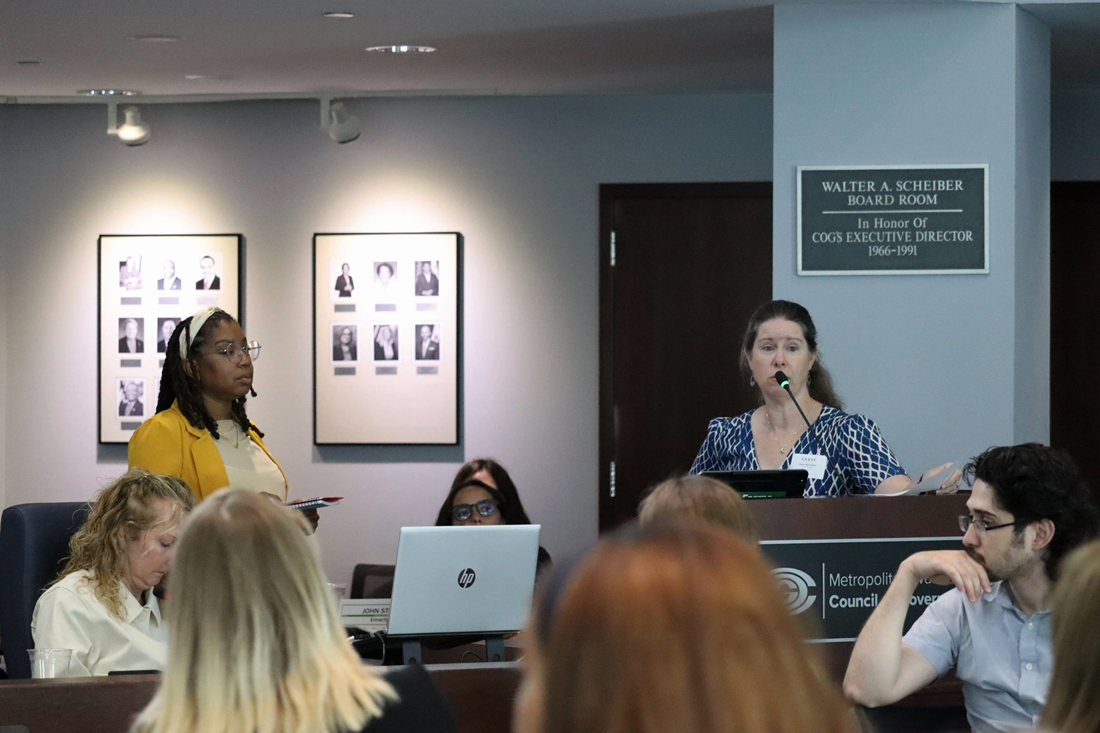
On July 18, the COG Food and Agriculture Regional Member (FARM) Policy Committee convened a policy forum at the direction of FARM Chair Andrew Friedson. The purpose was to discuss how recent changes in federal policy are affecting the region. The recently signed federal FY 2025 budget reconciliation bill, which makes historic cuts to the Supplemental Nutrition Assistance Program (SNAP) and Medicaid, was a key focus of the forum. The most concerning result of the new law: hundreds of thousands of people in the District of Columbia, Maryland, and Virginia, who are already facing food insecurity, will have to navigate decreases and changes to their benefits.
The forum showcased expert insights from two panels. The first focused on how recent federal policy shifts—including tariffs and funding changes—are impacting farmers’ decision-making, market access, and the broader food system. Kate Fitzgerald, a Principal at Fitzgerald Canepa, LLC, moderated the discussion between Gale Livingstone, owner of Deep Roots Farm in Upper Marlboro, Maryland; Charles Green, the Deputy Commissioner of the Virginia Department of Agriculture and Consumer Services; and James M. MacDonald, PhD, a research professor in the Department of Agricultural and Resource Economics at the University of Maryland.
The second panel examined how federal policy changes have impacted initiatives that get food to communities, such as schools and food banks. It also addressed how changes to SNAP and Medicaid will impact food-insecure residents and the broader implications for support organizations and local and state governments. Ona Balkus, who directs the Committee on Health for the Office of Councilmember Christina Henderson of the District of Columbia moderated the discussion, which featured Emma Jagoz, owner of Moon Valley Farm in Frederick County, Maryland; Salaam Bhatti, former SNAP Director at the Food Research and Action Center; and Sara Beckwith, Interim Senior Deputy Director at the Community Health Administration, DC Department of Health.
Committee members and stakeholders also discussed these and other challenges in smaller groups and shared their recommendations for maintaining progress in building a more resilient food system.

Throughout the forum, discussions centered on several significant challenges.
Increased burden on states, localities, and support organizations
“Food workers have been on the front lines since the pandemic, but they had an influx of funding then. Now we are going to be asked to do more with less. We’re going to see a period of increased demand and limited resources,” said Fitzgerald.
Panelists noted that states and localities will be forced to absorb the cost of federal cuts at an unprecedented level. For example, the new legislation will require each state to pay 75 percent (up from 50 percent) of the administrative cost to run SNAP. States will also be required to pay for a percentage of the cost of benefits, depending on their error rates in program administration (underpaid or overpaid benefits to eligible households). But the labor and resources required to reduce these error rates will require money too.
When DC, Maryland, and Virginia, are forced to pay millions they don’t have in their budgets, they will likely need to scale back or eliminate certain programs, removing entire households from assistance, explained Bhatti.
Organizations like food banks and school programs that get food into the hands of the most vulnerable residents are also being hit. First-generation farmer Emma Jagoz shared that Moon Valley Farm served 12 counties across Maryland through the Local Food for Schools Cooperative Agreement Program. The program allowed schools with budget constraints to purchase higher-quality foods while providing a steady and significant sales outlet for local farmers. The majority of the schools Jagoz served were Title 1, where many children did not have access to healthy food at home. Since the termination of Local Food for Schools in March 2025, while not easy, Moon Valley Farm has been building new partnerships to support farm viability and resilience.
Some of these cuts are already being felt, but others will have long-term impacts. Overall, the current administration will greatly constrain the role that the federal government plays in the agriculture sector going forward, Fitzgerald surmised. She said getting policymakers to realize the importance of Farm Bill legislation may prove more challenging in the future, too.
Innovating and improving existing resources and systems
Not all federal funding is being lost, and every remaining dollar must count. Panelists in both sessions emphasized that government resources must be accessible for people to actually benefit from them. They said now is the time to modernize and simplify the government processes that connect people to these resources, especially since states will be penalized for high SNAP error rates.
One speaker urged more connections among farmers growing fruits, vegetables, and other specialty crops, and Cooperative Extension in applied research projects. These could be funded by Specialty Crop Block Grants and ultimately help drive more business forward for farmers. This annually administered USDA program received additional funding in the reconciliation bill.
Opportunities for regional collaboration
Panelists discussed the challenge of uplifting local farmers while also making healthy groceries affordable. They noted the crucial role that communications and marketing play in making farmers and consumers aware of available resources. Committee members pledged to bring these stakeholders together to explore ways to distribute information more widely and consistently.
The committee also identified local procurement as a potential opportunity to invest in local farmers, acknowledging the cost of their labor, while also boosting the region’s food resilience.
“Food sustains us all. I know these are heavy times and really big issues, but we have to move these ideas forward because we have no other choice” said Ashley Drakeford, Director of Small Business Development at The Capital Market, who facilitated the forum’s roundtable discussions. “We have to take this opportunity to turn chaos into collaboration.”
In closing, Friedson recognized the talented and dedicated people working toward a more equitable food system. The pandemic began the process of local jurisdictions working together, he said, and now we must build an infrastructure that lasts not just in a crisis but in the long term. He plans to urge FARM members to look at existing food spending to find opportunities to work with local farmers.
Additional information about the FARM Policy Forum will continue to be posted on this webpage.