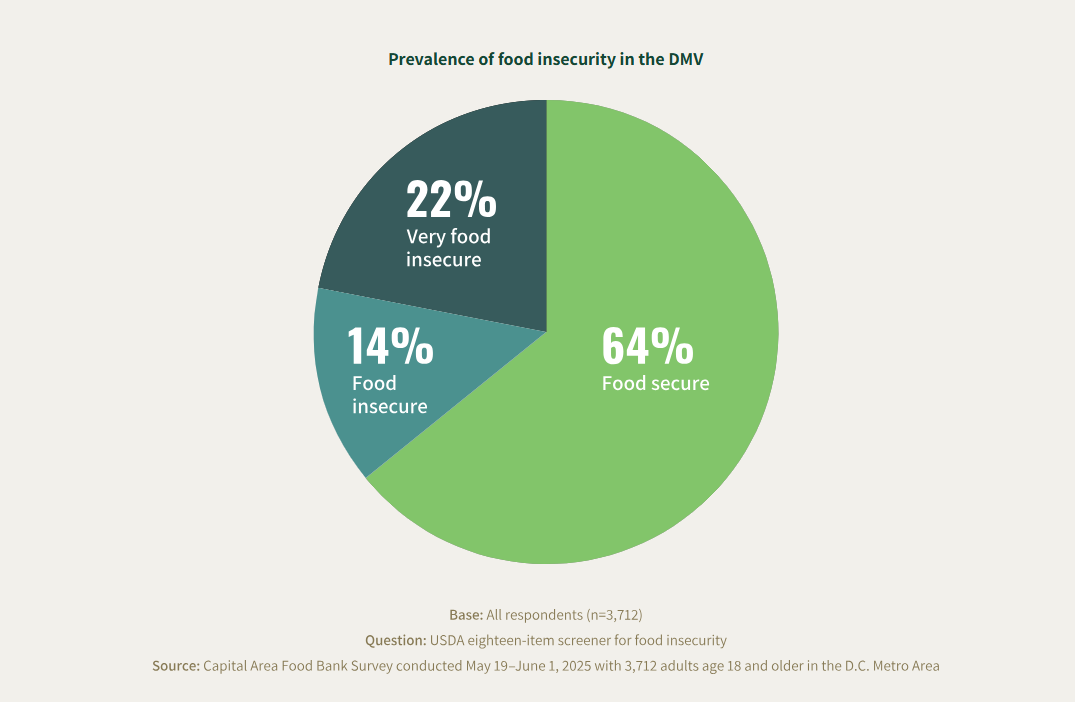
At the October meeting of the Metropolitan Washington Council of Governments (COG) Board of Directors, officials from across the District of Columbia, Maryland, and Virginia heard findings from the Capital Area Food Bank’s (CAFB) latest Hunger Report. The report, presented by CAFB’s Hilary Salmon and Sabrina Tadele, revealed that one in three residents in the region is food insecure, meaning they are uncertain where their next meal will come from.
Salmon said that food insecurity has risen sharply since the pandemic, driven by inflation, housing costs, and the expiration of emergency federal benefits. While need is highest in Prince George’s County and parts of the District, she emphasized that “food insecurity exists in every ZIP code.” Both presenters urged jurisdictions to support data-driven policies, strengthen safety nets, and engage employers in improving economic mobility.
Board discussion highlights
COG Board Chair and Fairfax County Supervisor Rodney Lusk called the presentation “sobering,” and noted his concern about the USDA discontinuing its national food security survey. Tadele stated the CAFB shares this concern and that it will continue its survey and collaborating with organizations like Feeding America, NORC and the Urban Institute to fill the national data gap.
Takoma Park Mayor Talisha Searcy observed that local nonprofits in her city are struggling as donations decline. “When federal workers lose income, that ripple effect hits our food providers,” she said. Salmon confirmed that many partners are under strain and that CAFB has used grants and extra food deliveries to fill gaps. Searcy also raised concerns about immigrants avoiding food sites due to fear of enforcement.
Frederick County Executive Jessica Fitzwater asked about the role of school meal programs and the low participation rates since pandemic-era universal meals ended. Tadele shared that only about 17% of food insecure households with children reported receiving free or reduced-price school meals, underscoring barriers to access. CAFB Advocacy Director Joe Lu added that federal changes to SNAP and Medicaid could jeopardize some schools’ automatic qualifications to serve free school meals to all students in high-need schools.
Prince George's County Executive Aisha Braveboy expressed concern over the high need in her jurisdiction and asked whether CAFB’s data identifies specific hot spots. Tadele explained that the food bank’s Hunger Heat Map tracks food insecurity at the census-tract level and is available publicly online. Salmon added that CAFB will share a custom data set with Prince George’s County to support targeted action. She noted that faith-based organizations, which make up a significant portion of the food bank’s network of distribution partners, are often highly trusted by communities and critical in reaching those who may avoid traditional aid channels.
Next steps
Chair Lusk thanked CAFB for its detailed presentation and praised local leaders for their engagement. He noted that the discussion demonstrated how food insecurity intersects with housing, wages, and equity, issues central to COG’s mission.
He also mentioned that COG’s Food and Agriculture Regional Member Policy Committee (FARM) and Human Services Policy Committee HSPC co-hosted a meeting in September ahead of the Hunger Report release, which included a roundtable with leaders of major food banks serving the region, and remarks from legislators in the Maryland and Virginia General Assemblies.
Based on the COG Board discussion as well as the joint meeting of the policy committees, Lusk said that COG would explore ways to support data collection and integrate food security metrics into its regional planning and advocacy work, building on the insights from the Hunger Report. The policy committees also plan to track both food assistance and Medicaid issues as they serve similar populations, explore coordination and dialogue to ensure that other policy changes benefit food-insecure families against the backdrop of cuts to essential federal programs, and to think about providing support to reduce food insecurity in a multi-year horizon.
MORE: CAFB Hunger Report and Interactive Hunger Heat Map