The COG Board of Directors evaluated the regional response to the major January 2026 winter storm during its recent meeting. Officials from the District of Columbia, Maryland, and Virginia jurisdictions discussed how regional coordination tools supported decision-making during the massive weather event, which was described as a “historic storm” by the National Weather Service due to its combination of snow and ice. COG’s new Board Chair Reuben Collins II stated that the purpose of this discussion was not to point fingers, but rather to be a learning experience that focuses on best practices and better preparation for future weather events.
Agencies successfully maintained essential services, with Metro facilitating over 2.6 million trips despite the conditions. However, the storm highlighted vulnerabilities in salt supply chains, contractor availability, and pedestrian access at intersections. Leaders noted that significant ice buildup led to trash collection delays and blocked transit lanes in several jurisdictions, including Alexandria, Montgomery County and the District of Columbia.
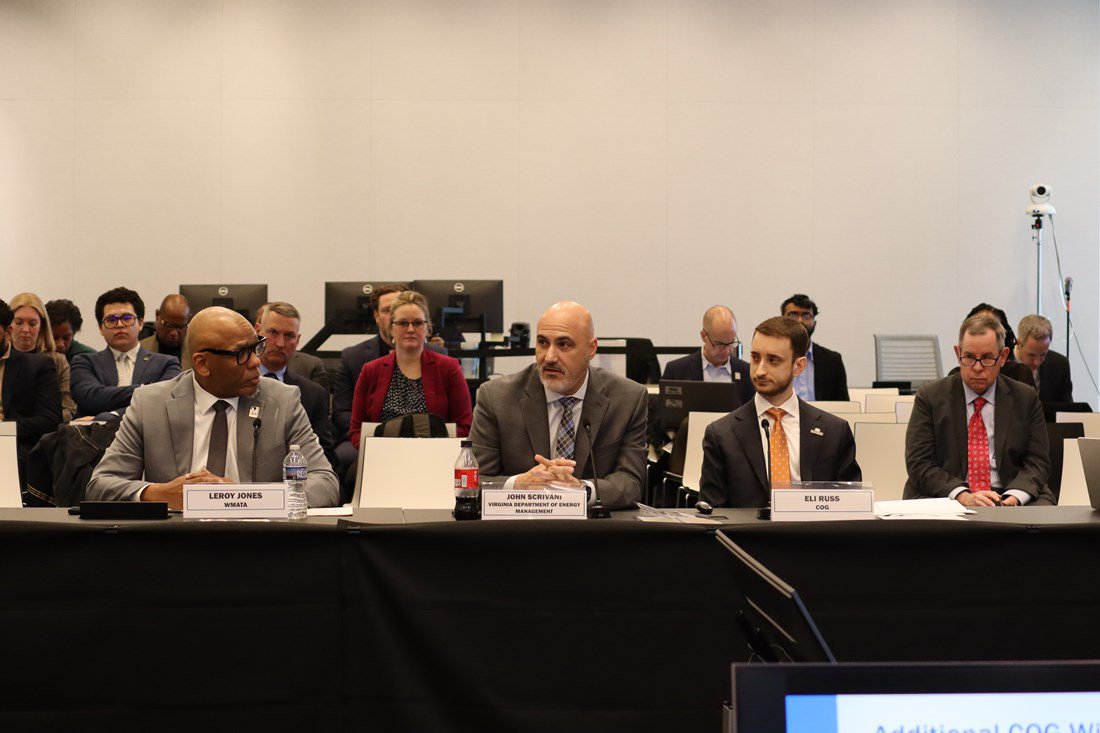
Leroy Jones from WMATA, John Scrivani from the Virginia Department of Emergency Management, and COG’s Eli Russ discuss the snowstorm response.
Key Discussion Points:
Regional Coordination and Information Sharing: COG Senior Public Safety Planner Eli Russ highlighted the coordination that took place at the regional level, including COG’s snow conference calls, bringing together the National Weather Service, the U.S. Office of Personnel Management (OPM), transportation and transit agencies, area governments, and other partners to discuss conditions, share info using regionalized terms, and collaborate on decisions in a regional context as part of the Regional Winter Weather Plan. The calls involved more than 600 participants. Additionally, the Regional Incident Communication and Coordination System (RICCS), COG’s 24/7 notification system for the region, provided a common operating picture for hundreds of officials.
Infrastructure and Supply Challenges: Kevin Donahue, City Administrator for DC Government, noted several challenges that occurred that were unique to this storm. There was a delay shipping salt into the region due to a single ship needing to dock in Baltimore. He suggested that diversifying the region’s supply chain could prevent a similar issue in the future.
Donahue also noted that the unique "snowcrete" and ice conditions required specialized hauling equipment rather than standard plows. The heavy ice damaged up to 20 percent of the city’s equipment, causing further challenges. Lastly, he noted that the former RFK stadium parking lot that was used to store snow this year will not be available as an option in the future, requiring new sites to be determined as suitable for depositing large amounts of snow and ice.
Communication Gaps: Officials at the COG Board meeting also addressed public communication gaps throughout the response. Montgomery County Chief Administrative Officer Rich Madaleno noted that intersecting state and county road-clearing responsibilities often confuse the public.
Mayor of Alexandria and COG Vice Chair Alyia Gaskins stated she started a daily video series to better communicate with her constituents, noting the need to clarify technical terms like "primary routes" and "passable roads" and keeping residents apprised about timelines on when their streets will be cleared.
DC Councilmember and COG Vice Chair Charles Allen highlighted that pedestrians have suffered the most in terms of mobility, having to walk over dangerous hills of snow and ice and waiting at uncleared bus stops. He stated that it could be beneficial to instruct contractors on more efficient ways to clear roads so pedestrian walkways aren’t buried. In addition, Allen noted the need to be better prepared to handle trash collection for future storms, which suffered massive backups from vehicles not being able to enter snow-covered alleys.
Regional Alignment and Contracts:
Board members also discussed the limited availability of contractors to help area governments respond to major storms. Donahue emphasized the need to over-procure snow removal contractors, noting that many often fail to arrive or redirect to other locations. Madaleno added that several mild winters have reduced the overall number of available contractors. Madaleno suggested implementing unified parking guidelines, such as "even/odd" rules (i.e., having all residents of a jurisdiction park on one side of the street before a storm and moving to the alternate side the following day), to help snowplows navigate narrow roads. Future regional efforts should focus on joint procurement and consistent parking regulations.
Moving forward, the Board is exploring regional improvements to bolster storm preparedness and response. Key priorities include developing a regional bus stop clearing plan, aligning emergency parking rules across jurisdictions, and leveraging AI and video technology for real-time road assessments. The Board remains committed to institutionalizing these lessons to prepare for future severe weather events.