The National Capital Region Transportation Planning Board (TPB) recently released a new travel demand forecasting model, the Gen3 model, that will make it easier for planners at the TPB and across our region to understand how and where people in the metropolitan Washington region are traveling---both now and in the future.
Every regionally significant transportation project that has been completed or is underway in the TPB region, such as the Silver Line in Virginia or the Purple Line in Maryland, uses a variation of TPB’s regional travel demand model. Even though the travel modeling process isn’t always easy to explain, and the process is more complex than what can be covered in this single TPB News highlight, the key takeaway is that the TPB travel demand forecasting model is at the core of transportation decision-making for TPB members.
Local planners, engineers, and decision-makers will rely on Gen3 modeling results and travel estimates to evaluate, recommend, and develop future transportation projects aimed at improving mobility and strengthening connections between activity centers in the District of Columbia, suburban Maryland, and Northern Virginia. Member jurisdictions determine project features and assess whether projects should be implemented by considering various factors, which include traffic and transit ridership forecasts generated by the TPB’s model.
Unlike TPB’s previous trip-based models, Gen3 is an activity-based model that simulates travel-related choices made by individual travelers with a much higher level of detail. Gen3 also expands the range of travel modes represented and offers the options to reflect telework, ride hailing, tolling, and recent shifts in how local households travel day to day.
Travel modeling process
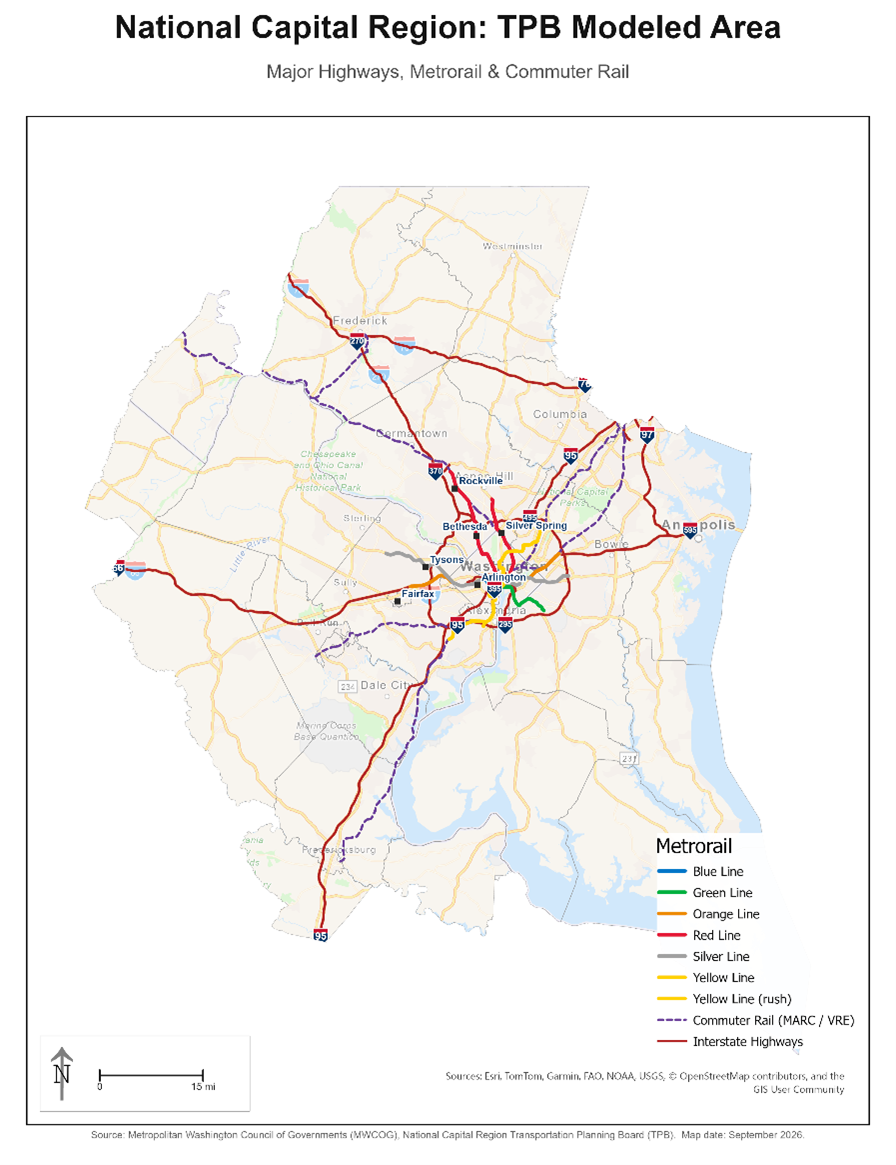
State, local, and regional transportation agencies use travel demand models to predict future traffic patterns and transportation infrastructure needs. TPB’s travel models provide estimates of current year and future conditions on the road and transit system. These estimates are conducted by using data from the U.S. Census and regional surveys along with transportation networks and land activity data for each transportation analysis zone (TAZ) in the area. TAZs are defined based on census tract, block group, and block geography. TPB’s regional travel forecasting models cover 6,800 square miles, including 22 local jurisdictions, with the region divided into roughly 3,700 TAZs.
Major sources of input data and assumptions for TPB’s travel models include:
- COG’s Cooperative Forecasts of Land Use
- Project assumptions\characteristics from TPB’s Visualize 2050 National Capital Region Transportation Plan and Transportation Improvement Program (TIP)
- Census data from the American Community Survey and Census Transportation Planning Products
- TPB’s Regional Travel Survey
- On-board transit surveys including Metrorail passenger surveys, regional bus surveys, Maryland Transit Administration, MARC, and VRE passenger surveys
- Commercial vehicle, auto, and truck surveys
- State and local government traffic counts
Once data sets are available, TPB’s modeling team uses specific software to generate travel forecasts through its regional travel demand models. Currently, TPB offers both the 4-step, trip-based Gen2 Model and the new, activity-based Gen3 Model for production use.
The new, activity-based model
The Gen3 travel model uses tour-based and activity-based approaches to simulate travel decisions made by individual travelers throughout the day. A tour records a series of trips (a trip chain) beginning and ending at a home or work anchor location—for example, travel from home to work with a stop at the grocery before returning home.
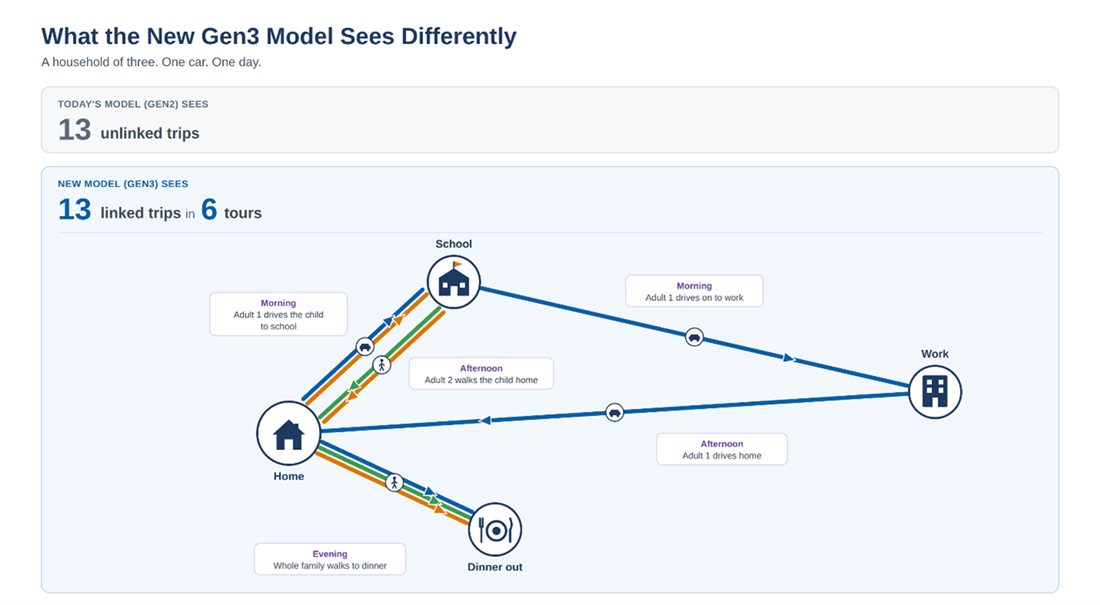
Gen3 more effectively captures the influence of household, person, and transportation network characteristics on travel behavior. This means that the Gen3 Model better reflects emerging transportation trends and policies mentioned earlier—such as telework, transit incentives, ride-hailing services, pricing strategies, and future mobility technologies.
In addition to travel forecasts, the TPB uses models to support mobile emissions modeling and air quality analyses, which, in turn, help inform the TPB’s long-range planning efforts such as the Visualize plan. While the Gen3 Model has not yet been used in air quality conformity analyses, it is available for planning studies, research, and scenario analyses. Staff anticipate that the Gen3 Model will be used for the next quadrennial metropolitan transportation plan update and the associated air quality conformity analysis.
Gen3 Model benefits
Overall, the Gen3 Model provides a more realistic framework that planners can use to evaluate transportation funding investments, study land use scenarios, and consider overarching regional mobility outcomes. The results of travel model-based studies and evaluations are shared with TPB member jurisdictions and TPB board members who approve regional fiscally-constrained metropolitan transportation plans for funding.
The Gen2 Model has been used successfully for decades and serves as the foundation for many regional planning activities, including air quality conformity analyses. Because many agency staff and member jurisdictions are already familiar with the Gen2 Model, and the implementation of Gen3 requires additional training and experience, the transition from Gen2 to Gen3 is expected to occur gradually.
Key takeaways
“From modeling trips to modeling people, Gen3 gives TPB a new lens for understanding travel behavior and how tomorrow’s policies can shape it.” Said Dr. Hadi Sadr, the program director of Travel Forecasting and Emission Analysis.
As noted earlier, the TPB travel demand forecasting model is at the core of transportation decision-making for TPB members.
Whether you live or work in the City of Frederick, Charles County, Loudoun County, the City of Manassas, or communities in between, the implementation of the Gen3 Model means that transportation decisions that affect your daily life will be informed by a more accurate and realistic understanding of how people travel throughout the region. By better reflecting actual travel behavior, the Gen3 Model provides a stronger foundation for planning investments, policies, and programs that meet the region’s evolving transportation needs.
Learn More
Both the Gen2 and Gen3 models are available for use by TPB member jurisdictions. In addition, members of the public, researchers, consultants, and other stakeholders may request modeling-related data. TPB staff provide this data and related information upon request, subject to staff availability and resource constraints.
TPB Travel Demand Forecasting
Request more information about the model.
Hadi Sadr, Ph.D., Program Director for Travel Forecasting and Emissions Analysis; Feng Xie, Ph.D., Manager of Model Development; Ray Ngo, Principal Transportation Engineer; and Dusan Vuksan, Program Manager of Model Application Group, contributed to this news highlight.