
The National Capital Region Transportation Planning Board (TPB) has announced the final schedule for development, review, and approval of the Visualize 2050 National Capital Region Transportation Plan, the FY 2026-2029 Transportation Improvement Program (TIP), and the accompanying Air Quality Conformity Analysis Report. The October–December 2025 time frame will feature key meetings and votes leading up to anticipated approval of the three documents.
Visualize 2050 outlines the region’s planned transportation investments over the next 25 years. As the federally designated metropolitan planning organization (MPO) for the DC-MD-VA area, the TPB’s approval of the plan is required for major transportation projects to receive federal funding.
As noted in the June 2024 TPB Meeting Recap, the board voted to amend the Air Quality Conformity Analysis Scope of Work by directing staff to conduct two alternative sets of regional air quality conformity analysis—one with the I-495 Southside Express Lanes project and one without the I-495 Southside Express Lanes project. With this request came a revision to the Visualize 2050 plan schedule to provide additional time for analysis and review of the two options. The TPB’s vote in October 2025 on whether to include the I-495 Southside Express Lanes project will inform the final report for the regional air quality conformity analysis, the Visualize 2050 plan, and the TIP.
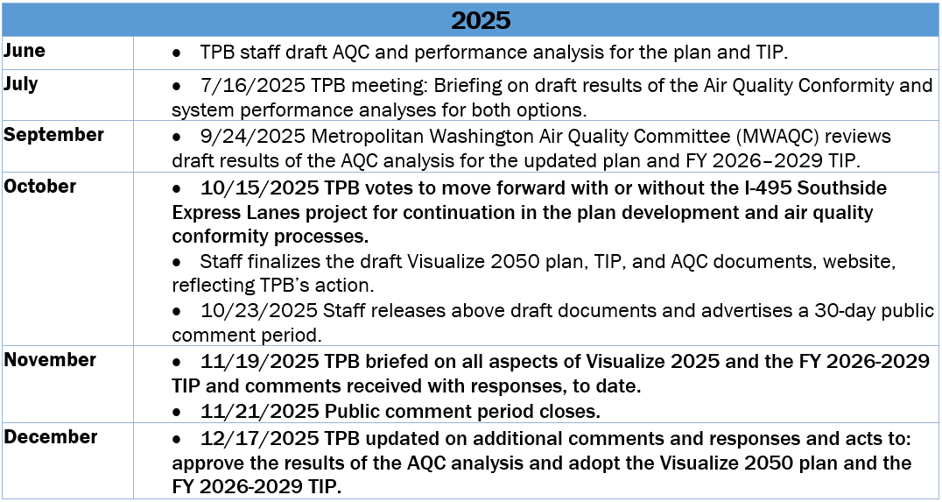
The schedule below reflects the final steps of Visualize 2050’s development. Key dates and votes are in bold. The 30-day comment period will run October 23-November 21, 2025. The draft plan, TIP, and Air Quality Conformity Analysis report will be available on visualize2050.org, where commenters can read the documents, comment, and find resources on how to share news about Visualize 2050.
Air Quality Conformity and performance assessment analysis results
An integral part of the Visualize planning process is the analysis of whether the plan’s regionally significant projects will impact air quality and how the future system is projected to perform. TPB staff recently completed an analysis on both, and the results were shared at the July meeting.
TPB staff conducted an air quality conformity analysis twice this year—with and without the I-495 Southside Express Lanes (SEL) project. The region is currently in attainment of National Ambient Air Quality Standards (NAAQS) for Ozone and is within its mobile emissions budget. In both instances, the Visualize 2050 plan meets the federal air quality conformity requirements. An analysis of other mobile source emissions finds that both fine particles and greenhouse gas (GHG) emissions are expected to decrease between today and 2050. For fine particles emissions, the model analysis resulted in a difference of 0.1% between the two I-495 options in 2050 (slightly lower emissions in the analysis with I-495 SEL) and the same GHG emissions for with or without inclusion of the I-495 SEL project.
Additional details and charts for air quality and system performance are available in the July Item 7 presentation.
Next steps
This summer, TPB staff will finalize the draft plan chapters and a Visualize 2050 executive summary. No committee meetings are scheduled in August. With fall on the horizon, the final steps to Visualize 2050 approval will kick into gear.
Look for updates in the coming months on the COG website, on the Visualize 2050 website, and in TPB News. Subscribe for Visualize 2050 news updates or follow the National Capital Region Transportation Planning Board on social media.