When the TPB News reported on dockless bikeshare in 2018, the only regional jurisdictions with programs were the District of Columbia and Montgomery County—and both were in the pilot stages of offering dockless micromobility through a variety of bikeshare companies. Flash forward to 2025, and the region is seeing more jurisdictions in suburban Maryland, Northern Virginia, and beyond instituting and expanding their programs to meet increasing ridership and a growing demand for personal mobility options.
While the transportation landscape has changed, information-sharing and interjurisdictional coordination remains important. The TPB regularly hosts a micromobility workshop where practitioners in DC and the surrounding cities and counties come together to learn the latest about each other’s systems, hear about new technology, and share lessons learned. The 2025 workshop was held on June 30 and featured updates from the District DOT, Capital Bikeshare, City of Alexandria, Arlington County, City of Baltimore, and Maryland Department of Transportation (MDOT). The following offers highlights and takeaways.
Bikeshare ridership trending upward
Representatives from the region’s jurisdictions and vendors all reported the same positive news—shared mobility ridership is on the rise as the system expands to reach more riders and meet demand.
District of Columbia DOT (DDOT)
- Lime, Hopp, Veo, and Spin are the four operators. The District of Columbia DOT (DDOT) is seeing record-breaking increases in dockless mobility ridership. In 2024, there were 8.6 million dockless trips not counting Capital Bikeshare.
- 2025 dockless ridership is up 43 percent compared to a year ago in 2024. Low-income riders are making 11 percent of the trips in DC.
- DDOT has detailed bicycle parking information on its website and has established off-sidewalk parking corrals. Shared dockless bicycles and scooters are required to be locked to a bike rack or other fixed object when not in use.
- DC now has over 113 miles of bike lanes, 35 miles of which are protected.
- DDOT’s micromobility hub site, https://sharedmobility.ddot.dc.gov/, provides resources, tips, and a 311 reporting form and dashboard.
Capital Bikeshare (CaBi)
- Capital Bikeshare is a publicly owned, non-profit bikeshare service that currently has over 7,000 bikes and 800 docking stations across 8 jurisdictions.
- 2024 was Capital Bikeshare’s best year ever with over 6 million trips taken by shared bicycle.
- Capital Bikeshare’s focus on state of good repair includes replacing stations that are greater than 10 years old, which equates to 140 of 206 stations (68 percent) being replaced.
- CaBi is rolling out Pillar docks, which will recharge e-bikes while they are parked. The Pillar system has a redesigned locking mechanism that makes it easier to quietly lock and unlock a bike.
- Pillar docks incorporate both solar and grid power to support charging. Pillar is more aesthetically integrated to the sidewalk environment and easier to move, making micro stations with fewer docks possible.
City of Alexandria
- Alexandria uses Capital Bikeshare, Lime, and GCOO, offering a mix of pedal bikes, e-bikes, and scooters. There are 71 CaBi stations in the city. Alexandria is one of a few U.S. jurisdictions using GCOO along with Memphis, Tennessee; Los Angeles, California; and Guam.
- The dockless permitting application process for existing providers is data centered with applicants required to illustrate what they are currently doing in response to eight prescribed metrics.
- Using Congestion Mitigation and Air Quality (CMAQ) funding and developer contributions, Alexandria plans to add 10 new stations and replace 22 stations as well as adding 160 new bikes.
- Alexandria CaBi ridership had its highest ridership year so far in 2024 with over 130,000 trips. Dockless mobility also experienced growth in 2024 with over 250,000 trips.
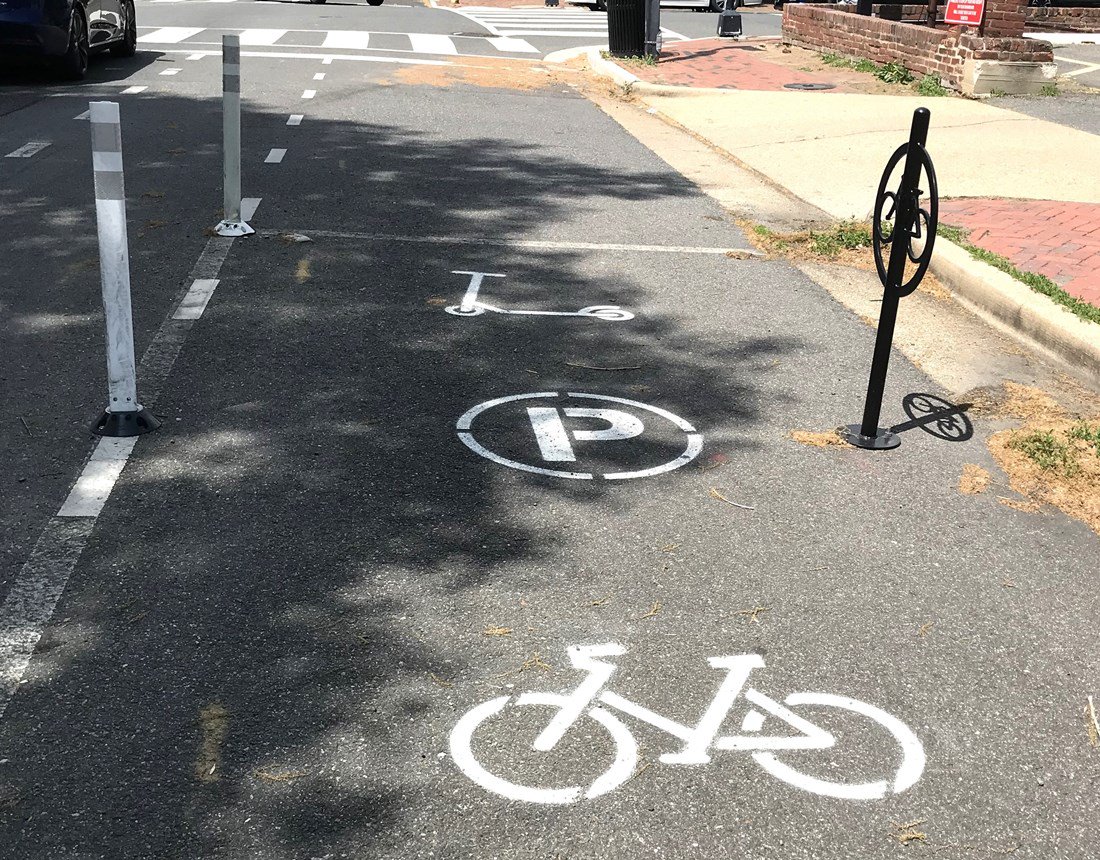
Bicycle and scooter parking on Cameron Street in Alexandria (COG)
Arlington County
- Arlington County kicked off its micromobility program with a pilot in 2018-2019. As of this year, the county offers 1,600 scooters and 505 e-bikes through Bird, Lime, and Spin. Arlington rules require that vendors must maintain 1.0 trips per device per day.
- The number of trip counts has increased even though the number of devices has decreased. Members of the public can check the county’s micromobility ridership statistics through a Ride Report dashboard.
- Arlington County has over 130 parking corrals with more on the way. Riders can suggest a location using the Arlington 311 app or website to report a problem or request service.
- Arlington offers flyers explaining age restrictions and alternative options for young travelers.
Maryland DOT
- Maryland’s 2050 Bicycle and Pedestrian Master Plan includes recommendations for micromobility and dockless vehicles—the first time the Bike/Pedestrian Plan has addressed personal and shared micromobility.
- MDOT has a new Micromobility in Maryland webpage.
- Capital Bikeshare operates in suburban Maryland, and Baltimore offers a variety of options.
- The Bike/Pedestrian Plan recommendations include operational guidance to cities, towns, and counties, “rules of the road’ safety guidance, parking design guidelines, and the long-term goal of a statewide e-bike rebate program.
- MDOT has started a Micromobility Working Group made up of jurisdictions with shared fleet permits to discuss best practices, the permitting process, and potential funding programs. This coming year, MDOT will focus on model permit language as well as point-of-sale and safety education. The MDOT in Motion webinar series is an additional resource for updates on Maryland’s micromobility, pedestrian, and bicycling initiatives.
City of Baltimore
- The City of Baltimore’s current micromobility fleet includes Spin e-scooter and e-bikes (2,800 scooters and 150 bikes). Lime is represented by a mix of 1,675 e-scooters, 75 seated scooters, and 600 e-bikes.
- Between June 2024 and June 2025, over 2.1 million trips were made with an average distance of 1.29 miles and an average trip duration of a little over 10 minutes.
- Twelve Equity Zones are mandatory deployment sites for at least four vehicles per operator every morning. Zones are located in underserved areas based on income, access to private vehicles, proximity to transit, population density, and demographics. Access Programs were established with both operators in June 2025, with the vendors agreeing to offer an 80 discount on all ride costs up to four trips a day.
Learn More
For more details, visit the 2025 Mobility Workshop page for the agenda, presentations, and recorded livestream.
The TPB is beginning the process of updating the Bicycle and Pedestrian Plan for the National Capital Region, which will have an expanded emphasis on the role of micromobility in the bike/pedestrian landscape. Follow the plan’s development through future Bicycle and Pedestrian Subcommittee activities (livestream available for all scheduled meetings) or by subscribing to TPB News for updates. For questions about bicycle and pedestrian planning activities, contact Michael Farrell, TPB Transportation Planner, mfarrell@mwcog.org.