The TPB met on June 18 and July 16, 2025. No TPB board meetings took place in August or September 2025. Highlights from the summer meetings and the July Steering Committee are featured here ahead of the board’s next meeting on October 15.
Featured Highlight: Visualize 2050 Update and Finalization of Inputs for Air Quality Conformity Analysis
In July, the TPB set the fall schedule for the Visualize 2050 National Capital Region Transportation Plan review and approval. The TPB will vote whether to move forward with or without the I-495 Southside Express Lanes (SEL) project in the plan at its October 15 meeting. A comment period will take place October 23-November 21, and the TPB will vote on plan approval on December 17, 2025.
The July meeting featured Visualize 2050 air quality conformity analysis and future system performance technical analysis results. Following an overview of the Visualize 2050 planning process and approvals to date from TPB Planner Cristina Finch, the second half of the presentation focused on the air quality and system performance analyses.
Air Quality Conformity Analysis
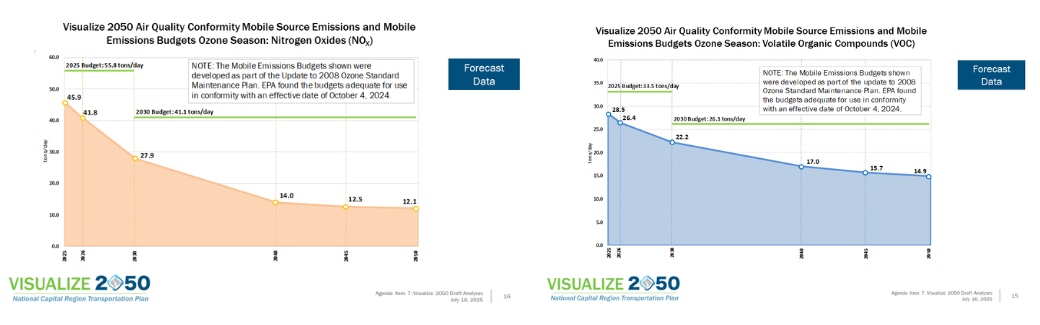
TPB Engineer Rob d’Abadie said that TPB staff conducted the air quality analysis twice, with and without the I-495 SEL lanes, and in both instances, the Visualize 2050 National Capital Region Transportation Plan met the air quality conformity requirements. During the analysis, total mobile emissions for VOCs and NOx fell below the established motor vehicle emission budgets. During the presentation, Rob d’Abadie noted that the total emissions were identical with and without the I-495 SEL lanes, and that “this is not to infer that the project has no impact, just that from a regional air quality perspective, the increases and decreases simply balanced each other out.”
(COG)
For additional information on the results, including other regional emissions measures, view the July 16 Item 7 meeting materials or listen to the presentation (time mark 47:29).
Future System Performance Analysis
TPB Planner Sergio Ritacco presented the technical analysis on future system performance. Performance analysis considers how well the anticipated transportation system will accommodate current and forecasted travel demand on the region's transportation system.
The TPB’s travel demand model relies on regional population and job forecasts from COG’s cooperative forecast process and the future transportation system, guided by information on existing travel patterns from the TPB’s travel survey. Ritacco reported that the TPB found that many of the measures of mobility, accessibility, congestion, and delay are not appreciably different with or without the I-495 SEL project.
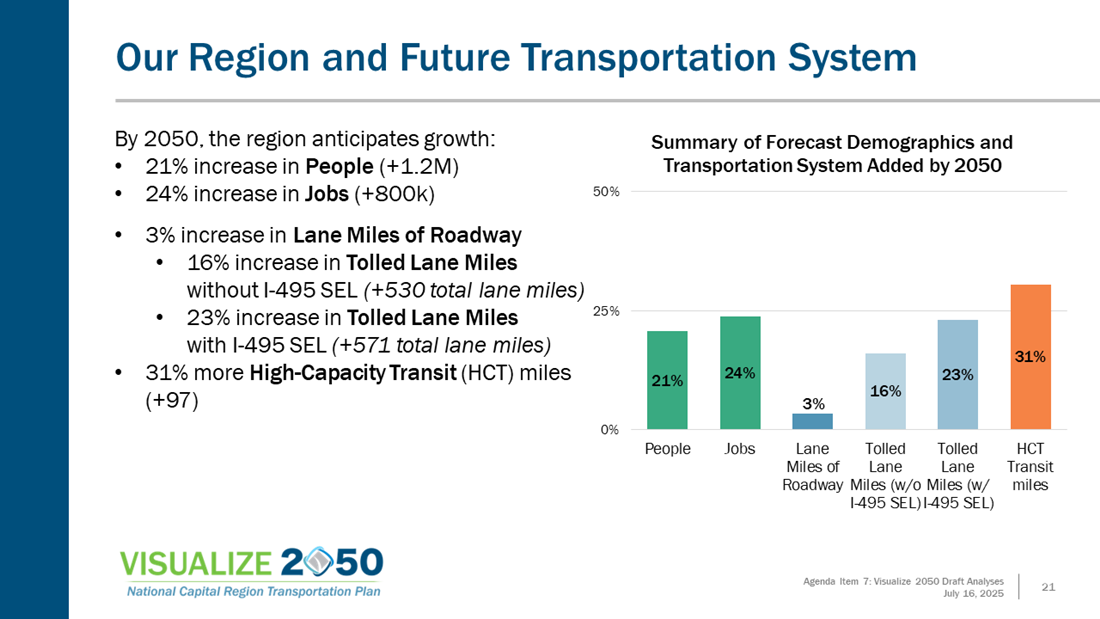
According to the system performance analysis, by 2050, population and job forecasts predict the region will add 21 percent more people (1.25 million individuals), and 24 percent (or an additional 800,000) jobs. The transportation system itself is projected to grow by a three percent increase in lane miles of roadway. By 2050, an increased share of people and jobs inside regional activity centers and close to high-capacity transit is forecasted. Overall, 46 percent of all jobs in the region will be near high-capacity transit.
(COG)
In terms of vehicle delay, total daily vehicle hours of delay regionwide will increase 67 percent with the I-495 SEL project and 70 percent without the project. Regionwide, the average person will be driving five percent less in 2050 than they do today, which can include people who are making shorter trips due to jobs and housing being in closer proximity, using non-auto-based modes, and changes to travel behavior due to the impact of congestion and delay. The I-495 SEL project has no appreciable impact on the results of this measure. The final data point shared is that the share of trips taken on non-single-occupancy-vehicle modes are forecasted to increase at rates greater than single-occupancy travel by 2050 and that by 2050, more than 62 percent of trips will be taken on non-SOV modes compared to 59 percent today.
Not all data points are shared in this summary. For complete details on the system performance analysis, view Item 7 materials or listen to the presentation (time mark 56:21).
Virginia DOT I-495 Southside Express Lanes Study Update
Michelle Shropshire, Virginia DOT (VDOT) Northern Virginia Megaprojects Director, updated the TPB on the Southside Express Lanes study, reviewing that VDOT had looked at 10 different study alternatives for the corridor between the I-495 Springfield interchange and MD 210, which includes the Woodrow Wilson Bridge. For the purposes of the air quality conformity analysis, VDOT selected two express lanes in each direction as a build alternative to address current and future needs. The build alternative consists of two buffer-separated express lanes in each direction on I-495 that would incorporate new express bus transit service and new bike and pedestrian improvements. VDOT has expressed its commitment to reducing the number of express lanes to provide space when the region is ready to implement future Metrorail on the Woodrow Wilson Bridge between Virginia and Maryland.
VDOT estimates that the corridor would be able to move up to 2,400 more people during peak hours with the express lanes, and general-purpose lanes would experience increases in travel speeds. Shropshire stated that total emissions and greenhouse gases have no negative impacts with the inclusion of the project, and the fine particle emissions are slightly lower with the project. The TPB will vote on October 15 whether to include the I-495 SEL project in the Visualize 2050 National Capital Region Transportation Plan.
During the board’s discussion, questions were asked about carpooling patterns in Virginia, WMATA’s future plans for the Blue Line, as well as potential congestion and travel time changes with and without the project. City of Rockville Mayor Monique Ashton noted that the project sets a precedence in terms of another state proposing toll lanes into the State of Maryland, and that “Maryland has to think about this very critically” ahead of the October 15 vote. Listen to the presentation and discussion via the July TPB meeting livestream (time mark 1:22)
June TPB Board Meeting
On June 18, the TPB heard about the 2025 Enhanced Mobility Program application period and received an update on the region’s transportation resilience work along with an overview on a new flood risk analysis using data from the Fathom-informed inland flooding model. June also included a DMVMoves update.
2025 Enhanced Mobility Program grant solicitation period underway
Cherice Sansbury, COG’s Enhanced Mobility Program Manager, presented information about the Federal Transit Administration Section 5310 Enhanced Mobility of Seniors and Individuals with Disabilities program. The TPB, with COG as administrative agent, provides approximately $10 million annually in matching grant funds for non-profit organizations, local governments, transit agencies, and private for-profit providers to use for capital and operating expenses. Enhanced Mobility services support accessible public transportation in the urbanized area. The 2025 application period closes September 30. A selection committee will present project recommendations to the TPB for approval at its December board meeting.
Read more about Enhanced Mobility and regional accessible transportation accomplishments.
Flood Risk Analysis
Using data from the Fathom U.S. Flood Map, the TPB identified significantly more transportation assets at risk from temporary inland flooding than an original analysis using FEMA flood maps. Fathom’s data includes pluvial (flash) flooding and projected floodplain expansion from heavier rainfall and stronger storms. The findings provide a more comprehensive understanding of total flood risk for transportation infrastructure, complementing existing data.
Katherine Rainone, TPB Planner, briefed the board on the new analysis, sharing that all transportation asset types (roads, bus stops, rail stops, rail lines) show increased exposure in both current (2020) and future (2030, 2050, 2080) scenarios. Details are available in New TPB flood analysis shows more regional assets vulnerable. The analysis garnered several media inquiries. Related interviews and coverage include:
New data map shows higher flood risks for roads and transit networks
(WTOP interviews COG Transportation Resiliency Planner Katherine Rainone)
New mapping reveals D.C. region’s growing vulnerability to flood risk
(Washington Post interview with Katherine Rainone)
DMVMoves Update
May 16 marked the one-year anniversary of the kick-off of DMVMoves. As progress continues on the joint COG and TPB initiative, the board received an update from Kanti Srikanth, COG Deputy Executive Director, and Eric Randall, COG Transportation Engineer, on working group development of a Regional Integration Action Plan. The Action Plan will focus on:
- Regional Fare Policy Integration to provide consistent customer experience
- Service Guidelines and Performance Reporting
- Consistent bus stop design, wayfinding, and customer information
- Bus priority strategies to maximize high-frequency routes
- Joint procurements and shared resources
- Shared training, certification, and inspection for consistency across the region
This summer, DMVMoves Working Group members developed feedback on these six areas. The TPB’s Community Advisory Committee, for example, held a detailed discussion at its July meeting to develop feedback that will be shared with the DMVMoves Community Partners Advisory Committee. The next DMVMoves Task Force meeting is scheduled for October 29.
July TPB Board and Steering Committee Meetings
Maryland Transportation Alternatives Set-Aside Program projects
At the July 2 TPB Steering Committee meeting, TPB Grants & Technical Assistance Program Manager Victoria Caudullo announced the FY 2026 Maryland Transportation Alternatives Set-Aside Program recommendations for funding. Projects are selected based on their anticipated ability to improve roadway safety, expand transportation options, support Regional Activity Centers, provide access to transit, offer access for low-income communities, support the National Capital Trail Network, and to offer safe access to schools and increased access for people with disabilities.
Two projects were approved:
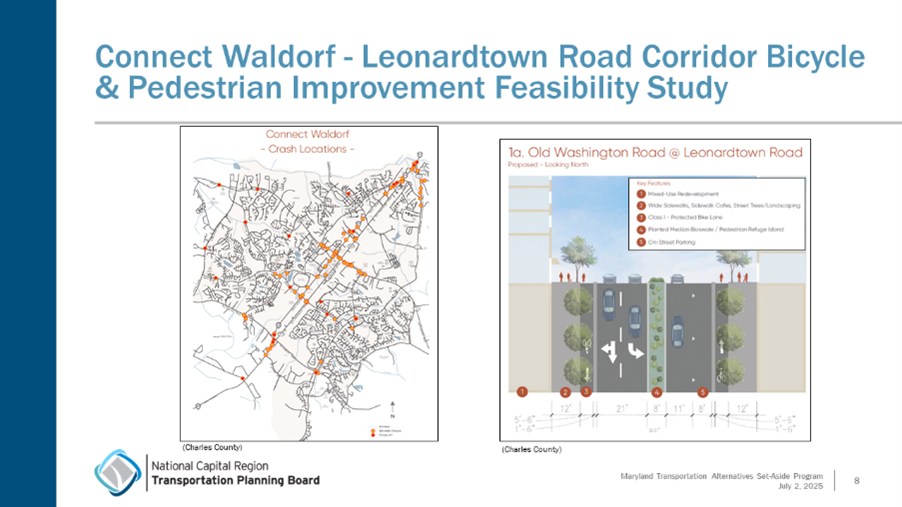
Connect Waldorf-Leonardtown Road Corridor Bicycle & Pedestrian Improvement Feasibility Study (Charles County, $102,000)
Connect Waldorf will complete a feasibility study to develop and analyze the 1.8 mile corridor between US 301 and St. Charles Parkway. The analysis will determine appropriate bicycle and pedestrian facilities for the corridor, identify right-of-way acquisition needs and constraints, identify improvements to intersecting streets and railroad crossings, and identify streetscape improvements to enhance safety. A design, construction, and cost estimate schedule are also part of the study.
(COG)
Prince George’s County Safe Routes to School Coordinator Position
(Prince George’s County, $231,005)
This project will fund a full-time Safe Routes to School (SRTS) Coordinator position for Prince George's County over a three-year period. The coordinator will establish a Safe Routes to School Program for the county, an initiative determined necessary to improving roadway safety in the county’s Vision Zero Action and Implementation Plan. The SRTS Coordinator will liaise with the Maryland DOT (MDOT) SRTS program and follow the MDOT toolkit to determine actions and initiatives that best fit the needs of Prince George’s County Schools.
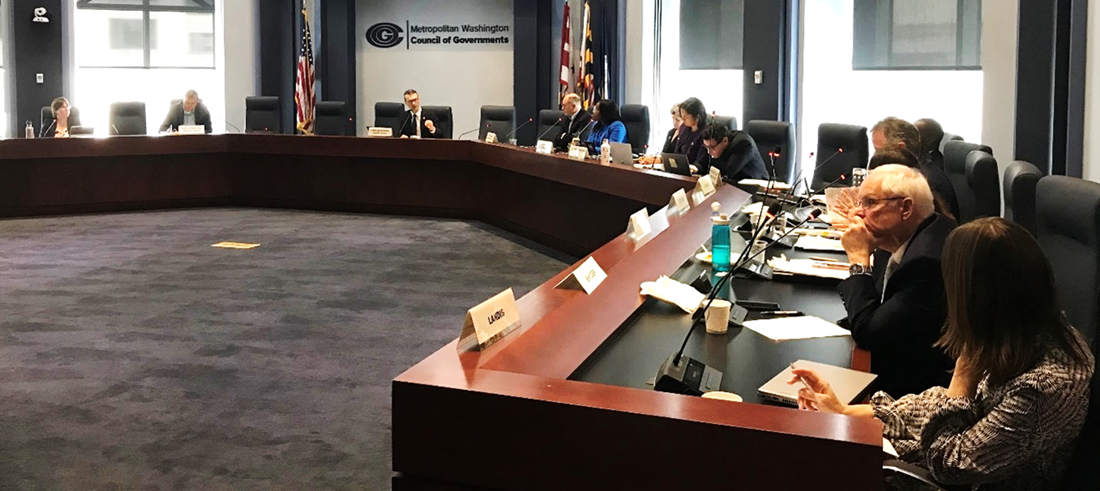
July 2025 TPB board meeting (COG)
Stay Connected
All agenda items, presentations, Director’s Reports, and the recorded livestreams are available on the June 18 and July 16 meeting pages.
Look for future announcements in TPB News and read highlights in the COG Newsroom, Subscribe to COG’s Regional Roundup for daily briefs on transportation in the DMV. The TPB board next meets on October 15 at 12:00 P.M.
Follow the TPB on Facebook, Instagram, and X/Twitter.
New! TPB is on Bluesky Social. Find us @NatCapRegionTPB.