The TPB’s May meeting featured approval of Transportation Land-Use Connections and Regional Roadway Safety projects, an overview of TPB’s congestion and travel analysis tools, and a look at the TPB’s updated Congestion Management Process Technical Report (CMP).
At their June meeting, the TPB approved a Virginia DOT Transportation Improvement Program (TIP) amendment. In addition, the TPB approved federally required performance targets for peak hours of excessive delay per capita and non-single occupancy vehicle mode share. The TPB also received a briefing on five new Regional Transportation Resilience Economic Analysis case studies.
At the July meeting, the TPB approved $2 million in federal Transportation Alternatives Set Aside Program (TA Set-Aside) funding for a shared use path in Montgomery County that will establish connections at Dr. Bird Road and Norwood Road in Olney, Maryland. Read more.
Additional Highlights and Actions
New Transportation Land-Use Connections and Regional Roadway Safety Program project approvals
The National Capital Region Transportation Planning Board (TPB) approved FY 2027 funding for twelve local planning projects, including six Transportation Land-Use Connections (TLC) Program projects and six Regional Roadway Safety Program (RRSP) studies. The two programs will support a total of $980,000 in consultant assistance for greenway guidelines, safety audits, bicycle & pedestrian network connections, and transit stop improvements. This year, all funded projects are in Maryland and Virginia.
FY 2026 TPB Congestion Management Process Technical Report
The TPB recently posted the updated Congestion Management Process (CMP) Technical Report presented to the board at the May meeting. The new report is an interactive StoryMap with an executive summary, key findings, and dashboards. The TPB conducts a CMP to provide for safe and effective integrated management and operation of the National Capital Region's multimodal transportation system. The process is based on a cooperatively developed metropolitan-wide. The FY 2026 CMP Technical Report includes a Strategies Series, Technical Appendix, and other resources. View the report.
Transportation Resilience: New Economic Analysis Case Studies
TPB Transportation Resiliency Planner Katherine Rainone briefed the board on a recent Regional Transportation Resilience Economic Analysis project that evaluated the costs of inaction and the benefits of proactive resilience investment across the National Capital Region’s transportation system. The analysis helps to show why investing in resilience matters. The study quantified the economic impacts of flooding and heat hazards and potential adaptation strategies and developed a risk-based framework and guidance to support future evaluation of additional assets and resilience projects. Five case study summaries offer key takeaways and a summary of regional implications:
- Anacostia Freeway (roadway)
- Army Navy Drive (bus stop)
- Greenbelt Station (rail stop)
- Liverpool Point Road (bridge)
- Silver Line (rail)
TPB Performance Target Approvals: Peak Hours of Excessive Delay per Capita and Non-Single Occupancy Vehicle Mode Share
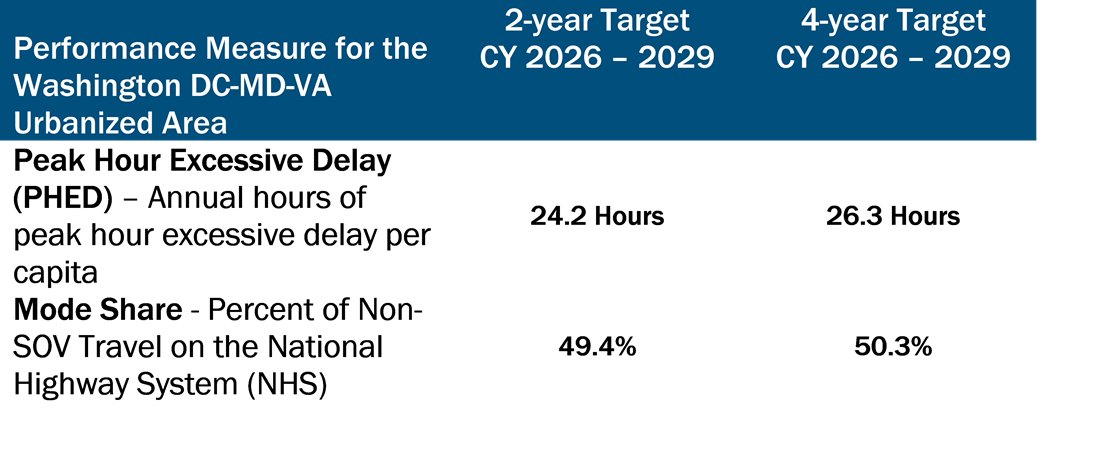
Ian Newman, TPB Program Manager, presented two-year and four-year targets for peak hours of excessive delay (PHED) per capita, which summarizes annual hours of excessive delay that's measured during the combined A.M. and P.M. travel peak periods (6:00 to 10:00 A.M. and 3:00 to 7:00 P.M.) based on data from the Federal Highway Administration-sponsored National Performance Management Research Dataset (NPMRDS). He also presented the same two-year and four-year CY 2026-2029 targets for the percentage of non-single occupant vehicle (SOV) commuting to work trips that are taken by transportation modes other than SOV travel, which includes teleworking. The SOV data is from the US Census Bureau's American Community Survey, five-year estimates. The board approved the targets in the table below.
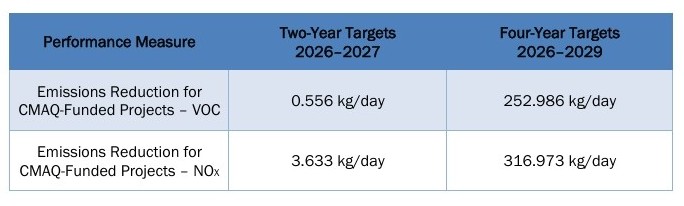
 CMAQ Improvement Program – On-Road Mobile Source Emissions targets
The TPB adopted a resolution at the July meeting to approve FY 2026-2029 targets for on-road emissions reductions for Volatile Organic Compounds (VOCs) and for Nitrogen Oxides (NOx) from congestion mitigation and air quality (CMAQ) funded projects. As a metropolitan planning organization (MPO), the TPB is required to coordinate with the District, Maryland, and Virginia DOTs to develop two-year and four-year targets for the portion of the Washington, DC-MD-VA nonattainment area within the metropolitan planning area. As part of this, the TPB calls on the transportation agencies of the region to continue to develop projects, programs, and policies to achieve reductions in on-road emissions. The approved targets are listed below. The list of related projects is provided below with details in the July Item 8 memo.
Virginia DOT Transportation Improvement Program (TIP) Amendment
The TPB adopted Resolution R15-2026, after board member discussion and public comment. This approval enables the Virginia Department of Transportation to revise its section of the recently approved FY 2026-2029 TIP to align with VDOT’s draft FY 2027-2030 Statewide Transportation Improvement Program (STIP). This action is taken because Virginia Statewide Improvement Program (STIP) years are not the same as the TPB's TIP. With the board’s approval, Virginia’s portion of the TIP increases from $2.6 billion to $7 billion. Item 7 of the June board agenda includes all details and affected projects. VDOT plans to provide the TPB with an update on the I-495 Southside Express Lanes Study later this calendar year.
Director’s Report and Additional TIP Amendments
TPB Staff Director Kanti Srikanth’s announcements, the TPB Steering Committee’s Transportation Improvement Program (TIP) amendment approvals, and letters of support are listed in the Item 5 memos on each meeting page.
Other Updates
TPB Freight Planning Highlight
The TPB Freight Subcommittee visited the Port of Baltimore in May to learn more about the Mid-Atlantic supply chain and to meet with Maryland Port Administration staff. This year, TPB staff begins the process of updating the National Capital Region Freight Plan. Learn more about the committee along with recent and upcoming freight planning activities in the region in the TPB News highlight.
Data Center Series Update
COG’s winter/spring 2026 data center series featured a final session on Land Use and Economics on May 26. The agenda, meeting summary, and a COG Data Centers Land Use Primer are available on the event page along with key takeaways and implications for decision-makers.
Stay Connected
Look for future announcements in TPB News and read highlights in the COG Newsroom. Subscribe to COG’s Regional Roundup for daily briefs on transportation in the DMV. The board next meets on September 16. In-depth information and board discussions are available through each meeting's live stream and board minutes.
Follow the TPB on Bluesky, Facebook, Instagram, and X/Twitter.